The Menopause Pantry: What Should I Eat in Menopause?
It’s 6 pm.
You open the fridge, stare inside and ask the question you’ve probably asked yourself a hundred times:
What am I supposed to eat?
There’s food in there.
You’ve got eggs. Some vegetables that need using. Maybe leftover chicken from yesterday. There are tins of beans in the cupboard, something lurking in the freezer and probably a jar or two you bought because somebody on Instagram told you they were really good for menopause.
You know you should eat more protein.
You’ve heard fibre is important.
You know vegetables are good for you, healthy fats matter and apparently you should be thinking about magnesium, omega-3, calcium, probiotics, blood sugar and about seventeen other things before you’ve even decided what to have for dinner.
And somehow, despite knowing more about nutrition than you ever have before, you still find yourself standing in front of the fridge thinking:
But what should I actually eat?
Perhaps that’s the problem.
We’ve been given more and more information about what women should eat during menopause, but very little help understanding how to use that information in our own bodies and our own kitchens.
Because a list of the “10 best foods for menopause” can’t tell you that you barely slept last night.
It doesn’t know that you skipped lunch because you were busy, that your digestion has felt sluggish all week, that you’re ravenous by 4pm or that lately you keep reaching for something sweet after dinner.
And it certainly doesn’t know what you’ve already got sitting in your fridge.
So what if you don’t need another list of foods to eat in menopause?
What if you need to understand what you’re trying to nourish?
That is where I believe menopause nutrition becomes much simpler.
Instead of constantly asking:
Is this food good for menopause?
We can begin asking:
What is my body telling me, and what might it need from me today?
Because the goal isn’t to become a nutrition expert.
It’s to become an expert in you.
And once you begin doing that, your menopause pantry becomes much more than a collection of healthy ingredients.
It becomes the place where you can take what you know about your body, combine it with the food you already have and turn it into something that genuinely nourishes you.
That is what I call The Menopause Pantry Method.
And it starts not with a meal plan, a calorie target or another set of food rules.
It starts with listening.
The Problem With Asking “What Should I Eat in Menopause?”
Type “what should I eat in menopause?” into Google and you’ll find no shortage of answers.
- Eat more protein.
- Increase your fibre.
- Get enough calcium.
- Eat oily fish.
- Add fermented foods.
- Balance your blood sugar.
- Cut carbohydrates.
- Eat more carbohydrates.
- Try fasting.
- Don’t fast.
And then there are the foods you’re told to avoid.
Sugar. Dairy. Gluten. Alcohol. Red meat. Saturated fat. Anything remotely enjoyable after 7pm…
No wonder so many women arrive in midlife feeling as though eating well has suddenly become incredibly complicated.
But I don’t think the problem is that we need more information.
I think we need to understand what to do with the information we already have.
Because knowing that protein is important doesn’t tell you whether the breakfast you ate this morning actually kept you satisfied.
Knowing that fibre supports your gut doesn’t tell you whether your digestion is functioning well.
Knowing that magnesium plays hundreds of roles within the body doesn’t automatically mean you need to buy a supplement.
And knowing that a particular food contains a long list of nutrients doesn’t necessarily tell you whether it belongs in the meal you need today.
This is where I think so much menopause nutrition advice misses the point.
It starts with the food instead of starting with the woman.
Your body isn’t exactly the same every day.
Your appetite changes.
Your energy changes.
Your digestion changes.
Your sleep changes.
Your stress levels change.
And during perimenopause, your hormones may be fluctuating too.
Add the seasons, your activity levels and, well… life into the mix, and expecting one perfect menopause diet to provide the answer suddenly doesn’t make much sense.
Nature doesn’t work like that.
Your garden doesn’t need exactly the same thing in September that it needed in June.
You wouldn’t water a plant simply because a gardening book told you that plants need water without first noticing whether the soil was already soaking wet.
You look. You notice. And then you respond.
Our bodies deserve the same curiosity.
So rather than beginning with:
“What foods should a menopausal woman eat?”
I want you to begin somewhere different.
Ask:
“What is my body telling me?”
Maybe you’re exhausted.
Maybe you’re hungry again an hour after eating.
Maybe your digestion feels sluggish.
Maybe you’re waking at 3am.
Maybe you’re constantly craving something sweet in the afternoon.
Those things aren’t instructions to immediately remove a food, buy a supplement or diagnose yourself with a deficiency.
They’re information.
They’re an invitation to get curious about what is happening in your body and whether there is something you could do to better support the systems that are working for you every single day.
And that changes nutrition from a set of rules you have to follow into a conversation you can have with your own body.
The Menopause Pantry Lesson
Stop asking whether a food is “good for menopause”.
Start asking:
What is my body asking for?
Because when you understand that, deciding what to put on your plate becomes a whole lot easier.
Your Symptoms Aren’t a Menu; They’re Information
This is where learning to listen to your body becomes important.
Because when something changes, it’s very easy to jump straight to the solution.
- Tired? Take a supplement.
- Bloated? Cut out gluten.
- Gaining weight? Eat less.
- Craving sugar? You need more willpower.
- Can’t sleep? It must be your hormones.
But what if, instead of immediately trying to silence the symptom, you got curious about it?
A symptom is a signal. It isn’t necessarily the problem itself.
Think about the warning light on your car dashboard.
You wouldn’t cover it with a sticker because you didn’t like looking at it.
But you also wouldn’t see one warning light and immediately order a new engine.
You’d investigate.
You’d ask what system the warning light relates to, what might be affecting it and what needs checking.
We can bring that same curiosity to our bodies.
Signal → System → Support
This is one of the simplest ways I think about menopause symptoms.
First:
What am I noticing?
Then:
What systems in my body could be involved?
And finally:
What does my body need to help those systems function optimally?
Let’s say you’re exhausted every afternoon.
Rather than immediately deciding you need an energy supplement, start with the foundations.
- Have you eaten enough today?
- Did your lunch contain enough nourishment to sustain you?
- How did you sleep last night?
- Have you been rushing around all day without stopping?
- Could you simply be tired?
- Or perhaps you’re hungry again an hour after breakfast.
Before blaming your blood sugar, ask what breakfast actually looked like.
- Was it substantial enough?
- Was there protein?
- Was there fat?
- Was there fibre?
Did you eat enough food?
Maybe your digestion has become sluggish.
Rather than immediately cutting foods out, you could look at what your digestive system needs to do its job.
- Are you eating a variety of plants?
- Are you getting enough fibre?
- Are you drinking enough?
- Are you moving your body?
- Are you actually sitting down and relaxing when you eat, or inhaling lunch between jobs?
Or perhaps every evening you find yourself standing in front of the cupboard looking for chocolate.
Instead of telling yourself you have no willpower, look backwards.
- What did you eat during the day?
- Were you trying to “be good”?
- Did you skip carbohydrates at lunch?
- Have you eaten enough?
- Are you genuinely hungry?
- Or are you exhausted, stressed and looking for comfort?
Suddenly, the craving becomes something to understand rather than something to fight.
And importantly, none of these examples means that one symptom has one cause.
Fatigue doesn’t automatically mean you need more protein.
Bloating doesn’t automatically mean you need more fibre.
Poor sleep doesn’t automatically mean you need magnesium.
Our bodies are far more complex than that.
Persistent, severe or new symptoms can also have causes that need proper medical investigation, which is why listening to your body includes knowing when something deserves to be checked by your GP.
But for the everyday signals our bodies give us, we can start by becoming curious rather than judgemental.
Signal → System → Support.
What am I noticing?
What might my body be trying to do?
What does it need to do that job well?
This is the difference between following generic menopause nutrition advice and beginning to understand your own physiology.
And once you start thinking this way, the question in front of the fridge changes again.
Instead of:
“What am I allowed to eat?”
It becomes:
“What could I eat that would nourish me right now?”
And that is where we head back into the kitchen.
The Menopause Pantry Method: Start With What You Have
So, we’re back in front of the fridge.
Only this time, instead of looking for the perfect menopause meal, we’re going to look at what you already have and ask a few simple questions.
This is how I want you to think about The Menopause Pantry Method.
It isn’t a meal plan.
There are no points to count, calories to track or complicated ratios to calculate.
And there certainly isn’t a list of foods you’re never allowed to eat again.
It’s simply a way of looking at a meal and asking:
How can I make this more nourishing for me?
1. What’s Going to Nourish Me?
Start with the substance of the meal.
What have you got that will give your body something useful to work with?
Perhaps it’s eggs, leftover chicken, fish, meat, Greek yoghurt, cheese, lentils or beans.
Protein is particularly useful to think about here because your body needs amino acids for far more than building muscle. They’re used throughout the body to make enzymes, neurotransmitters, immune proteins and other important compounds.
But this isn’t about turning dinner into a maths equation.
It’s about making sure there’s actually enough nourishment on the plate.
Sometimes the simplest question is:
Where’s the substance in this meal?
2. Where Are My Plants?
Next, look for plants.
Not because you need to create an Instagram-worthy rainbow at every meal, but because different plants bring different fibres, vitamins, minerals and plant compounds to the table.
And your gut microbes rather like variety too.
What’s in the vegetable drawer?
What’s growing in the garden?
Is there frozen spinach, peas or broccoli in the freezer?
A tin of tomatoes?
Some berries?
Fresh herbs?
Half a slightly wrinkly pepper that’s seen better days?
It all counts.
This is one of the reasons I love having a well-stocked pantry and freezer. Nourishing yourself doesn’t depend on having been to the supermarket that day.
Use what you’ve got.
3. What Will Make It Satisfying?
This is the bit diet culture has taught many of us to forget.
A meal isn’t successful simply because it’s low in calories.
It needs to satisfy you.
That might mean adding some potatoes, rice or sourdough.
It might be avocado, olive oil, butter, cheese, nuts or a creamy dressing.
It might simply mean putting enough food on your plate in the first place.
Protein, fats and fibre can all contribute to satiety, while carbohydrates provide an important source of energy.
But satisfaction isn’t only physiological.
It’s also the feeling that you’ve actually eaten something you wanted to eat.
Because if dinner leaves you wandering back into the kitchen 45 minutes later looking for something else, perhaps the answer isn’t more willpower.
Perhaps dinner just wasn’t enough.
4. What Will Make It Delicious?
Never underestimate this one.
Garlic sizzling in butter.
A squeeze of lemon over fish.
Fresh rosemary from the garden.
A spoonful of mustard stirred into a sauce.
Cumin, paprika or chilli transforming a tin of beans.
A handful of Parmesan over roasted vegetables.
Food is allowed to taste good.
In fact, I’d argue that learning how to make simple real food delicious is one of the most useful nutrition skills you can have.
This is where your pantry becomes a little bit magical.
Those jars of herbs and spices, bottles of good oil, homemade ferments, stocks, vinegars and condiments aren’t just extras.
They’re what can turn “I’ve got some chicken and vegetables” into something you actually look forward to eating.
Nourishment should never feel like punishment.
5. What Does My Body Need Today?
And finally, come back to you.
How do you feel today?
Are you ravenous because you’ve been on the go all afternoon?
Do you want something warming and comforting because it’s cold and grey outside?
Has your appetite disappeared because you’re stressed?
Are you in perimenopause and noticing that your appetite, energy or cravings seem different at different points in your cycle?
Maybe you’re post-menopause and beginning to notice your own rhythms through the seasons, your energy, sleep and daily life instead.
There isn’t one correct answer.
Your body isn’t static, so your nourishment doesn’t need to be either.
This is where cyclical and seasonal eating starts to make so much sense to me.
Nature changes.
Our food changes.
Our energy changes.
And our bodies change too.
Instead of expecting ourselves to eat exactly the same way every day of the year, we can learn to respond.
Just as we did with the garden.
Look. Notice. Respond.
So when you next open the fridge, don’t ask yourself whether you can create the perfect menopause meal.
Look at what you have.
Think about how you feel.
Then ask:
What can I make from this that will nourish me?
That’s The Menopause Pantry Method.
Not perfection.
Capability.
What Does This Look Like in a Real Kitchen?
Let’s make this practical.
You don’t need a recipe for every meal. Sometimes you just need to look at what you’ve got and start putting the pieces together.
I’ve got eggs, potatoes and vegetables that need using.
That could become a frittata, omelette or hash. Add some cheese, herbs from the garden and perhaps a simple salad.
Protein. Plants. Carbohydrate. Fat. Flavour.
I’ve got lentils, a tin of tomatoes and half a drawer of tired vegetables.
Add some stock, garlic and spices and you’ve got the beginnings of a soup, curry or stew. Perhaps there’s leftover chicken to throw in, some Greek yoghurt for the top or sourdough to mop it up.
Nothing particularly fancy.
Just real food, put together in a way that nourishes you.
I’ve had a long day and I really cannot be bothered to cook.
Then don’t make life harder than it needs to be.
Scrambled eggs on sourdough with tomatoes. Greek yoghurt with fruit and nuts. Soup from the freezer. Leftovers reheated with a handful of greens.
Nourishment doesn’t only count when you’ve cooked it from scratch.
This is why I don’t want you to leave this post with another meal plan.
I want you to leave with the confidence to open your fridge, pantry, freezer or wander into the garden and think:
What have I got, what do I need, and what can I make from it?
That’s a skill you can use for the rest of your life.
The Goal Isn’t to Eat Perfectly. It’s to Learn Your Rhythm.
Everything we’ve talked about so far is the foundation.
You can start today.
Open your cupboards, look at what you have, listen to your body and build a nourishing meal.
But there’s another layer to The Menopause Pantry Method.
Because your body doesn’t exist separately from the rhythms of nature.
Just as your needs aren’t exactly the same from one day to the next, they aren’t necessarily the same throughout the month or across the seasons either.
If you’re still cycling during perimenopause, you may already notice differences in your appetite, energy, mood, sleep or cravings at different points in your menstrual cycle, which may also have changed in length or flow.
The trouble is that during perimenopause those cycles can become increasingly unpredictable.
So rather than trying to force an irregular body into a perfectly organised 28-day plan, I like to use another rhythm that’s been there all along.
The moon.
The moon gives us a gentle framework for checking in.
A time to restore.
A time to build.
A time to notice what’s working.
A time to release what isn’t.
Not because the moon is dictating what you must eat on a Tuesday night, but because it gives us a rhythm to come back to when our own feels harder to find.
Then there’s the bigger cycle happening outside the kitchen window.
The seasons.
The foods appearing in September aren’t the same foods nature was offering us in June.
Our routines change.
The temperature changes.
The amount of daylight changes.
What we’re growing, buying, and naturally wanting to eat begins to change too.
That’s why, in [A Menopause Pantry Isn’t About Stockpiling. It’s About Resilience], we started this Virgo cycle by looking at the pantry as something that helps you feel prepared rather than restricted.
Then in [Protein for Menopausal Women: How to Build a High-Protein Menopause Pantry], we looked beyond simply knowing that protein is important and started thinking about how we actually use real food to nourish the body.
And last week, in [Autumn Pantry Swap: Seasonal Eating for Menopause], we began changing the kitchen itself as we moved from summer into autumn and looked at our own internal thought swaps, taking this much deeper.
Now we put those pieces together.
👉🏼Prepare your environment.
👉🏼Understand your body.
👉🏼Notice the rhythm you’re in.
👉🏼Then nourish accordingly.
That, for me, is where menopause nutrition becomes something much more powerful than following a meal plan.
You begin to notice.
You eat.
You see how you feel.
You adjust.
And over time, you learn your own patterns.
Maybe certain meals sustain you better.
Maybe your appetite changes at particular points in your cycle.
Maybe you naturally want different foods as the moon moves through its phases.
Maybe autumn makes you crave warming soups, stews and roasted roots while summer draws you towards salads, berries and food straight from the garden.
You don’t need to turn any of this into another set of rules.
That’s exactly what we’re trying to get away from.
Instead, you’re learning to live and eat a little more cyclically.
To work with your body rather than constantly trying to control it.
To reconnect with the seasons rather than expecting yourself to function exactly the same way 365 days of the year.
And to create a kitchen that changes with you.
That’s the deeper work behind The Menopause Pantry.
It isn’t simply teaching you which foods are healthy.
It’s teaching you how to understand your changing body, recognise the rhythms around you and use real food to respond.
Because ultimately, I don’t want you to spend the rest of your life needing somebody else to tell you what you should eat.
I want to teach you how to know.
Want to Understand What Your Body Is Asking For?
If you’re reading this thinking, this makes so much more sense than another menopause diet, I’d love to help you take the next step.
On Wednesday 7th October, and future New Moon Wednesdays – follow the link to find the latest date if October has passed – I’m hosting a free live workshop where we’ll go deeper into why you can be eating “healthily” and still feel inflamed, exhausted or as though your body simply isn’t responding in the way it used to.
Rather than giving you another list of foods to eat or avoid, I’ll help you start connecting the dots between the signals your body is giving you, the systems that may need more support, and how you can use food and your everyday environment to nourish them.
Because once you understand what your body is asking for, what should I eat? becomes a much easier question to answer.
Not ready for the workshop?
Start by creating the foundations with my free Menopause Pantry Principles – a simple guide to building a kitchen filled with real, nourishing food without calorie counting, complicated meal plans or another list of foods you’re not allowed to eat.
[Download the Menopause Pantry Principles]
Because menopause doesn’t need another diet.
It needs a woman who knows how to listen to her body and a pantry that helps her respond.
🌙 This Week’s Moon Kitchen Recipe
Moon Phase: 🌗 Last Quarter | Support
Moon Kitchen Focus: Nourish your nervous system, support progesterone production and respond to increased hunger with protein, healthy fats and satisfying carbohydrates.
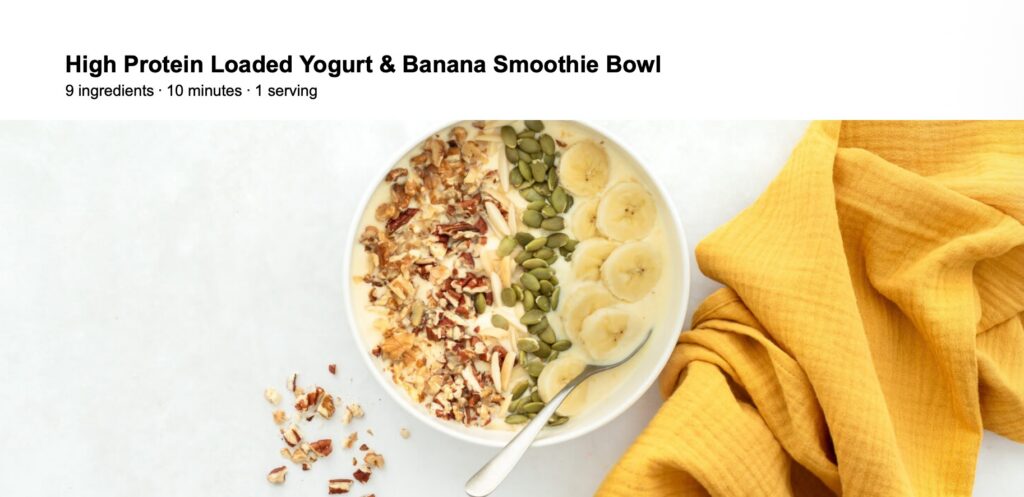
This Week’s Recipe: High Protein Loaded Yoghurt & Banana Smoothie Bowl
As we move into the Last Quarter Moon, our focus shifts towards slowing down and supporting the body.
Mirroring the luteal phase, this is a time when hunger can naturally increase, and that’s something to nourish rather than fight.
This loaded smoothie bowl combines protein-rich Greek yoghurt and protein powder with banana, nuts, seeds and peanut butter, providing protein, magnesium, calcium, B6, healthy fats and carbohydrates. Together, they create a satisfying meal that supports muscle, the nervous system and steadier energy.
Even after menopause, the body continues to produce small amounts of progesterone, so this phase remains a beautiful reminder to reduce stress, eat enough and give your body the nourishment it needs.