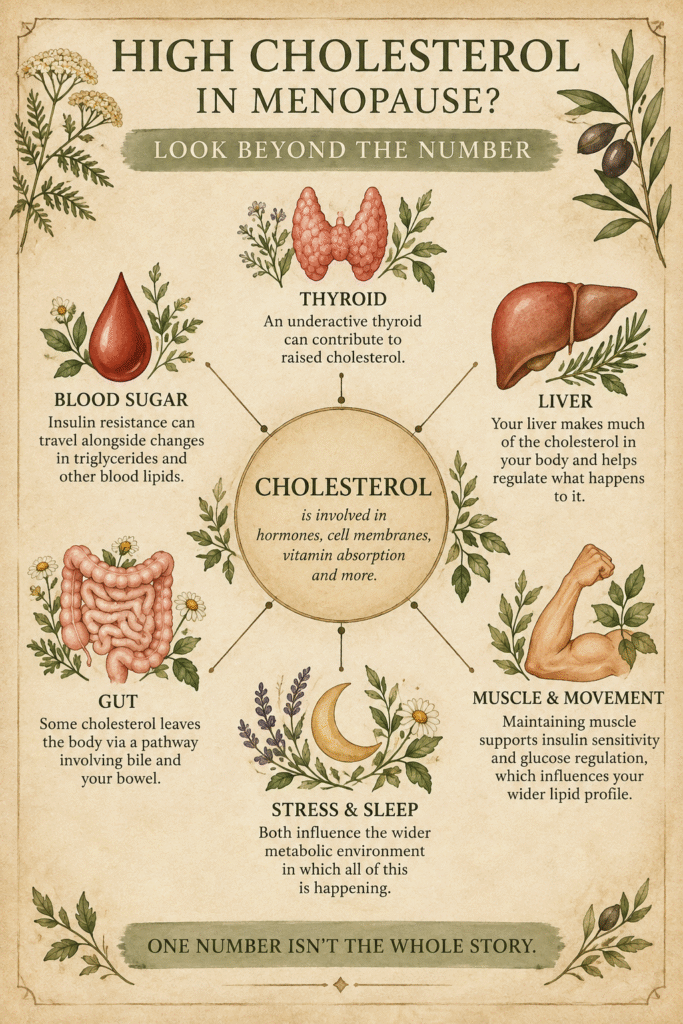
High Cholesterol in Menopause: What Is Your Body Trying to Tell You?
Are You Still Scared of Cholesterol?
Seven years ago, in October 2019, I published a blog for National Cholesterol Month.
I’d only been in business for a couple of months, and much of what I wrote reflected what I’d been taught about cholesterol at the time.
There was good cholesterol. There was bad cholesterol. And if the bad cholesterol was too high, the obvious question was:
How do we lower it?
Seven years later, I would ask a very different question.
What if, before trying to lower cholesterol, we asked why the body makes it in the first place?
Because cholesterol isn’t some useless substance floating around the bloodstream waiting to clog our arteries.
Your body makes cholesterol deliberately.
It forms part of every cell membrane. It’s used to make bile acids, which help us digest fats. It’s involved in vitamin D production. And particularly relevant during menopause, cholesterol is the raw material from which our steroid hormones are made.
Progesterone. Estrogen. Testosterone. Cortisol.
Suddenly, describing cholesterol simply as “bad” starts to feel rather inadequate.
So when did a substance our body needs become something we’re so frightened of?
Over the years, the conversation around cholesterol has increasingly become a conversation about numbers: what your total cholesterol should be, how low your LDL should be and at what level intervention should begin.
And those recommendations haven’t stood still.
Today, NICE recommends looking at cardiovascular risk rather than relying on a single cholesterol cut-off. For primary prevention, statins are generally offered from a 10% ten-year QRISK3 cardiovascular-risk score, while treatment can also be considered below that threshold following an informed discussion. NICE explicitly recommends considering lifestyle, other health conditions and the individual’s preferences when making that decision. Nice
Meanwhile, cholesterol-lowering medication has become extraordinarily commonplace. Atorvastatin alone was dispensed 73 million times in England during 2024/25, making it the country’s most frequently dispensed medicine. NHS BSA Open Data
That doesn’t mean statins are inherently bad, nor that nobody benefits from lowering LDL. There is good evidence that lowering LDL reduces cardiovascular events in people at elevated cardiovascular risk, particularly those who already have cardiovascular disease. Nice
But I do think we’re entitled to ask a bigger question.
Are we becoming so focused on lowering the number that we’ve forgotten to ask what is happening in the body?
Because your cholesterol result doesn’t exist in isolation.
Neither does your blood sugar.
Or your thyroid.
Or your liver.
Or your gut.
Or your hormones.
And this is where my approach to menopause has changed enormously since I wrote that first article seven years ago.
Today, I don’t want to teach you to fight individual numbers or symptoms.
I want to teach you to understand the terrain in which they’re appearing.
That’s what we’re going to explore in this article.
Not “How do I get my cholesterol as low as possible?”
But:
What does cholesterol actually do, why can our numbers change during menopause, and what else should we be looking at before we decide that cholesterol itself is the enemy?
Cholesterol Isn’t the Villain
Before we talk about why cholesterol can change during menopause, we need to understand what cholesterol actually is.
Because despite decades of being told to fear it, cholesterol isn’t something your body is desperately trying to get rid of.
Your body makes it for a reason.
In fact, cholesterol is so important that although we can get some through food, most of the cholesterol in our bodies is made internally, primarily by the liver.
And it has some pretty important jobs.
Cholesterol helps form the membranes surrounding every cell in your body. It’s needed to make bile acids, which help you digest and absorb fats. It’s involved in the production of vitamin D.
And then there’s the part I think every woman approaching menopause should understand:
Cholesterol is the starting material for your steroid hormones.
Your body uses cholesterol to make pregnenolone, which then sits at the beginning of the pathways used to produce hormones including progesterone, cortisol, testosterone and estrogens.
So perhaps cholesterol deserves a little more respect than simply being labelled good or bad.
After all, your body wouldn’t go to the trouble of making something it had absolutely no use for.
But what about ‘good’ and ‘bad’ cholesterol?
This is something I would definitely change from the article I wrote seven years ago.
Back then, I described HDL as good cholesterol and LDL as bad cholesterol.
But HDL and LDL aren’t actually cholesterol.
They’re lipoproteins, particles that transport cholesterol and other fats around the bloodstream. Cholesterol can’t simply travel around in our watery blood by itself, so it needs a transport system.
LDL generally carries cholesterol from the liver out towards tissues where it can be used, while HDL participates in transporting cholesterol back towards the liver.
That doesn’t mean LDL doesn’t matter. Higher concentrations of LDL-containing particles are associated with atherosclerotic cardiovascular disease, which is why an elevated result shouldn’t simply be dismissed.
But reducing the whole conversation to:
HDL = good.
LDL = bad.
doesn’t really help us understand what is happening inside the body.
And understanding is what I’m interested in.
Your body needs cholesterol. That doesn’t mean more is always better.
This distinction is really important.
I’m not suggesting that because cholesterol is essential, we should celebrate an increasingly high cholesterol result or ignore cardiovascular risk.
Essential doesn’t mean unlimited.
Glucose is essential too. We wouldn’t therefore conclude that persistently high blood glucose doesn’t matter.
Instead, when something starts moving outside its expected range, I want to become curious about why.
- What’s happening with blood sugar and insulin?
- How well is the liver functioning?
- What about thyroid function?
- What’s happening in the gut?
- Has activity changed?
- What role are stress, sleep and our changing hormonal environment playing?
And importantly for women in midlife:
What changes during the menopause transition itself?
Because cholesterol doesn’t suddenly exist in a vacuum when we turn 45.
It exists within a complex, interconnected body that is going through one of the biggest physiological transitions of a woman’s life.
And that brings us to the much more interesting question:
Why Can Cholesterol Rise During Menopause?
If you’ve reached your 40s or 50s, had a routine blood test and suddenly been told your cholesterol is higher than it used to be, you’re certainly not alone.
Cholesterol levels can change during the menopause transition, and the risk of developing high cholesterol increases during and after menopause.
The conventional explanation often focuses on declining estrogen.
And there is some truth in that. Our changing hormonal environment affects the way we metabolise fats, where we store body fat, how sensitive we are to insulin and our cardiovascular system more broadly. Blood pressure, glucose regulation and cholesterol can all change around this stage of life.
But I think there’s a danger in stopping the conversation there.
Because if we simply say:
Estrogen falls → cholesterol rises
we’re once again looking at one hormone and one number rather than the whole woman.
And menopause is rarely that simple.
What else changed?
Think about what can be happening during the very same years.
👉🏼 Perhaps you’re sleeping badly.
👉🏼 You’re under more stress.
👉🏼 Your body composition is changing.
👉🏼 You’ve lost some muscle.
👉🏼 You’re moving less because you’re exhausted, achy or simply juggling too much.
👉🏼 Your blood sugar isn’t behaving quite as predictably as it once did.
👉🏼 Your thyroid may need investigating.
👉🏼 Your liver is still processing hormones, producing cholesterol and making bile.
👉🏼 Your gut and bowel habits may have changed.
Maybe the foods you’ve been eating for years suddenly don’t seem to work quite so well for you anymore.
None of these things happens in isolation.
In fact, recognised causes and contributors to high cholesterol include menopause and ageing, but also type 2 diabetes, an underactive thyroid, liver and kidney disease, genetics, smoking, physical inactivity and other lifestyle factors.
This is why I don’t want menopause to become another diagnosis that stops us asking questions.
If your cholesterol rises at 52, saying “Well, you’re menopausal now” might describe part of what is happening.
It doesn’t necessarily explain the whole picture.
Menopause is a transition, not a malfunction
This is an important distinction in my work.
Our ovaries changing their hormone production as we move through menopause is normal physiology.
That doesn’t mean we ignore changes in our cardiovascular health. Quite the opposite. Midlife is an excellent time to become more interested in our blood pressure, blood sugar, lipids, muscle, metabolic health and future cardiovascular risk.
But I don’t believe the goal should be to make a menopausal body behave exactly like a 30-year-old body.
The goal is to understand what this body needs now.
And sometimes a changing blood marker can be an invitation to look more closely.
Not with fear.
With curiosity.
Look beyond the cholesterol number
This is where I’d encourage you to ask better questions.
If your cholesterol has increased, what does the rest of your lipid profile look like?
- What are your triglycerides doing?
- What about your HDL and non-HDL cholesterol?
- What’s your blood pressure?
- How is your blood sugar?
- When was your thyroid last checked?
- What’s your family history?
- What are your sleep, stress, movement and eating patterns actually like?
Because even conventional cardiovascular assessment doesn’t rely on total cholesterol alone. Your GP considers cholesterol alongside other risk factors when assessing your overall likelihood of cardiovascular disease.
One number is information. It isn’t the whole story.
And this is where we arrive at something I talk about again and again in The Healthy Menopause.
Instead of immediately trying to silence the signal, look at the environment in which that signal appeared.
Or, as I like to think of it:
Look at the terrain.
Your blood sugar, liver, gut, thyroid, stress response, sleep, movement, nourishment and hormones aren’t separate departments operating independently of one another.
They’re part of the same beautifully interconnected body.
And if we want to understand why something has changed, that’s where we need to start looking.
Instead of Fighting the Number, Look at the Terrain
This is where my approach to cholesterol, and menopause, more generally, has changed the most.
When something changes in the body, our instinct is often to focus on the thing we can measure.
Cholesterol is high? Lower the cholesterol.
Blood sugar is high? Lower the blood sugar.
Weight has increased? Lose the weight.
But what if the number we’re looking at is the end of the story rather than the beginning?
What if, instead of immediately asking how to make the number smaller, we became curious about the environment in which that number changed?
I like to think of this as looking at the terrain.
Your body isn’t a collection of separate parts
Cholesterol doesn’t exist in its own little compartment.
It’s connected to your liver, your digestive system, your thyroid, your blood-sugar regulation, your hormones and your overall metabolic health.
That’s why, when I work with women through The Menopause Pantry, we come back to the foundations again and again.
Not because there’s one magical menopause diet.
But when we support the systems responsible for keeping the body functioning optimally, we create a better internal environment for everything else to work within.
Start with blood sugar
Blood-sugar balance is one of my foundations for a reason.
Insulin resistance and disturbances in glucose metabolism commonly travel alongside changes in triglycerides and other blood lipids. You might also notice increasing hunger, energy crashes, cravings, more weight accumulating around your middle or finding that meals which once kept you satisfied no longer do.
Rather than seeing each of these as separate problems, I want you to start connecting the dots.
This is why a Menopause Pantry meal starts with real food: plenty of protein, fibre and nourishing fats, with carbohydrates chosen and combined in a way that supports steadier blood sugar.
We’re not restricting food.
We’re creating a better metabolic environment.
Then look at the liver
The liver has an enormous role in this conversation.
It manufactures much of the cholesterol circulating in the body, helps regulate cholesterol levels and uses cholesterol to make bile acids.
And bile isn’t simply something we need to digest fat.
Bile is part of the route through which the body disposes of cholesterol. Cholesterol is converted into bile acids, released into the digestive tract and, although much of it is recycled, some is eventually eliminated through the bowel.
Suddenly liver → bile → gut → bowel becomes one connected story.
Which brings us beautifully to another Pantry foundation.
Feed the gut
Remember the oats and barley I recommended in my original 2019 cholesterol article?
I still love them.
But now I want you to understand why rather than simply eating them because you’ve been told they’re “cholesterol lowering”.
Soluble fibres such as beta-glucan can bind bile acids in the digestive system and increase their excretion. The liver then needs to draw on cholesterol to make more bile acids.
Fibre also feeds our gut microbes, supports regular bowel movements and contributes to the wider metabolic environment.
So rather than thinking:
I need to eat this food to lower my cholesterol.
Try thinking:
What foods help this system do its job properly?
That’s a very different relationship with food.
Don’t forget the thyroid
This is one I think women should know about.
An underactive thyroid can contribute to raised cholesterol because thyroid hormones are involved in the regulation and clearance of lipids.
And some of the things we associate with menopause, tiredness, feeling cold, constipation, weight changes, dry skin or hair changes, can overlap with symptoms of an underactive thyroid.
That doesn’t mean every woman with high cholesterol has a thyroid problem.
It means that “you’re menopausal” shouldn’t necessarily be the end of the investigation.
If your cholesterol has changed significantly, particularly alongside other symptoms, it’s reasonable to discuss thyroid function and the wider picture with your GP.
Muscle and movement matter too
Movement isn’t punishment for something you’ve eaten.
Muscle is metabolically active tissue and plays an important role in glucose disposal and insulin sensitivity.
As we move through midlife, maintaining muscle becomes increasingly important, which is why walking, carrying, gardening, lifting weights, and other forms of resistance exercise aren’t simply about burning calories.
They’re ways of supporting the terrain.
And then there is stress, sleep and the nervous system
This is another reason I resist reducing menopause health to food.
You can have the most beautifully stocked Menopause Pantry in the world, but if you’re chronically stressed, barely sleeping and running on empty, that’s part of your physiological environment too.
Cortisol itself is one of the steroid hormones whose synthesis ultimately begins with cholesterol.
That doesn’t mean stress is “using up” all your cholesterol or stealing your other hormones; our bodies are considerably more sophisticated than that.
But it does remind us that metabolism, hormones and the nervous system aren’t separate conversations.
And sometimes the most nourishing thing you can do isn’t add another supplement.
It’s go to bed.
Take a walk.
Eat a proper meal.
Get outside.
Slow down.
This is what I mean by supporting the terrain
I’m not suggesting that improving your gut or balancing your blood sugar makes an elevated LDL result irrelevant.
Nor am I suggesting that medication is never appropriate. There are people for whom cholesterol-lowering medication can meaningfully reduce cardiovascular risk.
I’m saying something much simpler:
Don’t let the number stop the investigation.
Ask what else is happening.
Look at your blood sugar.
Support your liver and gut.
Check your thyroid when appropriate.
Build and maintain muscle.
Eat enough real, nourishing food.
Sleep.
Manage stress.
Know your family history.
And recognise that your body has rhythms too, daily rhythms, hormonal rhythms, seasonal rhythms and the enormous transition of menopause itself.
This is the foundation of The Menopause Pantry.
We don’t chase every symptom with another restriction.
We create the environment in which the body has what it needs to function as well as it can.
Because perhaps the most useful question isn’t:
“How do I get my cholesterol down?”
Perhaps it’s:
“What does my body need from me now?”
What About the Fat We Eat?
If cholesterol is high, it’s understandable that one of the first things women are told to do is cut down on fat.
And this is where food can quickly become frightening.
Eggs. Butter. Cheese. Full-fat yoghurt. Avocado. Nuts. Olive oil.
Suddenly we’re scrutinising foods our grandmothers would have recognised while supermarket shelves are full of highly processed low-fat alternatives.
But dietary fat and blood cholesterol aren’t the same thing.
Your body makes most of the cholesterol it needs itself, primarily in the liver.
Dietary cholesterol can affect blood cholesterol, but the response varies between individuals, and our overall dietary pattern and metabolic health matter too.
That doesn’t mean the type and quality of fat we eat is irrelevant. Rather than fearing fat altogether, I prefer to focus on fats from real, minimally processed foods, extra-virgin olive oil, oily fish, avocado, nuts, eggs and good-quality dairy, as part of an overall nourishing diet.
But I don’t think the answer is to become afraid of fat.
Fat has a job to do
Fat helps us absorb the fat-soluble vitamins A, D, E and K. It provides essential fatty acids, contributes to cell membranes, makes food satisfying and provides some of the raw materials our bodies need to function.
So inside a Menopause Pantry, I’m much more interested in the quality of the food than simply whether something contains fat.
Think oily fish, extra-virgin olive oil, avocado, nuts, eggs and other minimally processed whole foods alongside plenty of colourful plants and fibre.
Not because they’re menopause superfoods.
Because they’re food.
And our changing bodies still need nourishing.
Nourish, don’t punish
This is perhaps the biggest difference between the cholesterol article I wrote in 2019 and the one I’m writing today.
Back then, I was asking:
What should we remove to lower cholesterol?
Today I’m far more interested in:
What can we add to help the body function well?
Protein. Fibre. Nourishing fats. Colourful plants. Fermented foods. Herbs and spices. Proper meals made from recognisable ingredients.
Because menopause doesn’t need another restrictive diet.
It needs a well-stocked pantry.
This Is Why I Created The Menopause Pantry
If you’ve read this far, you might have noticed something.
We’ve started with cholesterol, but we’ve ended up talking about blood sugar, insulin, liver function, bile, gut health, thyroid, muscle, stress, sleep, hormones and food.
And that is precisely the point.
Nothing happens in isolation.
It’s why I became increasingly frustrated with menopause advice that gives women another symptom to treat, another food to avoid or another supplement to buy.
I wanted to create something different.
The Menopause Pantry is built around understanding and supporting the foundations: blood-sugar balance, gut and liver health, nourishment, movement, stress and the nervous system – alongside the natural rhythms of our bodies, the moon and the seasons.
Not because doing all of those things guarantees perfect cholesterol, perfect hormones or perfect health.
There is no such promise.
But because these are the everyday foundations we can influence.
It’s about learning to notice the signals your body gives you and becoming curious about what sits underneath them.
Signal → system → support.
Rather than spending menopause fighting your changing body, you begin learning its language.
And perhaps that’s the biggest difference between the cholesterol article I wrote seven years ago and this one.
Back then, I wanted to tell you how to lower the number.
Today, I want to help you understand the body producing the number.
🌿 The Pantry Takeaway
If you only take one thing from this…
Cholesterol isn’t simply something bad that needs to be driven as low as possible. It’s an essential substance your body uses every single day, including to build cell membranes and make bile acids and steroid hormones.
That doesn’t mean high cholesterol should be ignored.
It means we can replace fear with curiosity.
Instead of only asking “How do I lower my cholesterol?”, start asking:
“What else is happening in my body, and what does it need from me now?”
Because menopause isn’t about controlling your body harder.
It’s about finally learning how to work with it.
🌙 This Week’s Moon Kitchen Recipe
Moon Phase: 🌗 Magic Extra Week | Support
Moon Kitchen Focus: Support the luteal phase with vitamin B6, fibre, protein and satisfying carbohydrates to nourish the nervous system and support steady energy.
This Week’s Recipe: Salmon with Vegetable Noodle Stir Fry
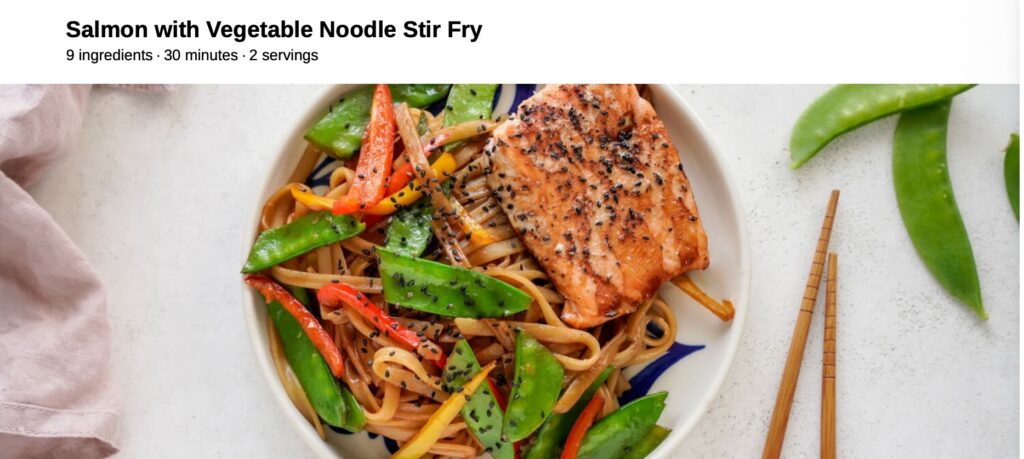
We have a little Magic Extra Week before the next New Moon, so we’re staying with our Last Quarter focus and giving the body a little more support.
This colourful Salmon with Vegetable Noodle Stir Fry combines protein and healthy omega-3 fats from salmon with rice noodles for satisfying carbohydrates and plenty of colourful vegetables for fibre and micronutrients. Salmon also provides vitamin B6, one of the nutrients we focus on during the luteal phase because it contributes to normal hormone regulation and nervous-system function.
The extra fibre from the vegetables supports the gut and healthy elimination, while the combination of protein, fats and carbohydrates creates a genuinely satisfying meal, exactly what we want when appetite may naturally increase during the luteal phase.