Autumn Pantry Swap: Seasonal Eating for Menopause.
As autumn arrives, seasonal eating for menopause can be as simple as taking stock of what you already have, using up the last of summer’s produce and gradually bringing in more seasonal foods for the cooler months ahead.
Think squash and root vegetables, apples and pears, lentils and beans, oats and whole grains, warming herbs and spices, homemade stocks and the ingredients for soups, stews, curries and traybakes.
But an autumn pantry swap isn’t about throwing out everything in your cupboards and starting again.
It’s about allowing your kitchen to change with the season and perhaps allowing yourself to do the same.
As the days become shorter and the temperature begins to drop, it’s completely natural to find yourself reaching for warmer, heartier foods.
Your appetite may change. Your energy may feel different. The crisp salad you happily ate in July might suddenly feel far less appealing than a bowl of something warm and comforting.
And rather than seeing that as something you need to resist, what if you became curious about it?
Because nature doesn’t expect everything to stay the same all year round.
At the autumn equinox, we reach that beautiful turning point between summer and winter. The abundance of summer begins to give way to a slower season of gathering, preserving and preparing for the months ahead.
For me, that’s what The Menopause Pantry is really about.
Not a perfectly organised cupboard full of so-called superfoods, but creating a kitchen that makes it easier to nourish yourself while learning to notice what your changing body is asking for.
So before you rush out to buy pumpkin spice everything, although I do have a recipe collection for that 😉, let’s have a look at what you already have and begin preparing your pantry for autumn.
Mabon: The Turning of the Wheel
There is something deliciously witchy about this time of year.
The jars begin filling the pantry shelves. Apples pile up in bowls. Herbs are gathered and dried. The last of the garden’s abundance is picked, preserved, bottled and tucked away for another day.
For those who follow the Wheel of the Year, the autumn equinox is often celebrated as Mabon, a time associated with harvest, gratitude and balance as we stand at the threshold between the light and darker half of the year.
And I think there is something rather beautiful in that for women in midlife.
We spend so much of our earlier lives in seasons of doing.
Building careers. Raising families. Caring for other people. Keeping homes. Meeting expectations. Producing. Achieving. Giving.
Then menopause arrives with its own turning of the wheel.
Perhaps this season of our lives isn’t asking us to keep producing at the same pace.
Perhaps it’s asking us to gather.
To take stock of what we’ve grown.
To keep what nourishes us.
To preserve the wisdom we’ve collected along the way.
And maybe to let some things fall away.
Our ancestors had no choice but to pay attention to the seasons. They knew when the berries appeared, when the apples were ready, which herbs to gather and what needed preserving before winter arrived.
We’ve lost much of that relationship with the natural world.
Food appears on supermarket shelves regardless of season, electric lights allow us to ignore the darkness, and modern life encourages us to keep going at roughly the same pace all year round.
But the wild woman in us still notices.
She notices the first chill in the morning air.
The blackberries in the hedgerows.
The smell of woodsmoke.
The urge to pull on a jumper, light a candle and put something bubbling on the stove.
Perhaps reconnection begins by paying attention to those little nudges again.
You don’t need to dance barefoot around a bonfire under the full moon – although I’m certainly not going to stop you 😉
It might simply mean picking some apples. Making a pot of soup. Drying the herbs from your garden. Filling a jar with something you’ve made yourself. Sitting outside with your morning coffee and noticing that the season has changed.
Small acts that remind us we are part of nature, not separate from it.
And that feels like a rather lovely place from which to begin our autumn pantry swap.
Before You Buy Anything, Shop Your Kitchen
There is something about a new season that makes us want to buy things.
New candles. New jumpers. New notebooks. And apparently an entire new pantry because someone on Pinterest told us we need twelve different kinds of seeds and a £9 jar of adaptogenic mushroom powder.
We don’t.
Before you write an autumn shopping list, shop your own kitchen first. If you would like a checklist to help you do this you can download one for free HERE.
Open the cupboards.
Pull out the baskets.
Have a rummage through the freezer.
Look at the jars lurking at the back of the pantry and the vegetables in the fridge that need using before they become compost.
What do you already have?
You might be surprised.
A half bag of lentils. Three tins of tomatoes. Some oats. A lonely tin of butter beans. Rice. Stock. Spices you bought for one recipe six months ago. Frozen vegetables you’d completely forgotten about.
None of it is particularly exciting on its own.
But that’s where pantry knowledge becomes far more useful than simply owning the right ingredients.
Those lentils, tomatoes and spices could become a warming dhal.
The butter beans, stock and vegetables could become soup.
Oats, apples and cinnamon could become breakfast or a crumble, because nourishment is allowed to be delicious too.
This is one of the reasons I talk so much about food resilience.
A well-stocked pantry isn’t about having enormous quantities of food sitting on shelves. It’s about knowing how to turn what you have into something nourishing when you need it.
Have an Autumn Pantry Audit
Take ten minutes and look at your kitchen with fresh eyes.
What needs using first?
Bring anything approaching its best-before date towards the front.
What did you rely on over summer but aren’t reaching for anymore?
You don’t need to throw it away. Use it, freeze it if appropriate, or simply move it aside to make room for the foods you’re naturally reaching for now.
What’s coming into season?
Look at what’s growing in your garden, appearing at the farm shop or becoming abundant and affordable locally.
What could you preserve for later?
Apples can become sauce or chutney. Herbs can be dried or frozen. Late summer vegetables can become soups, sauces and ferments.
Where are the gaps?
Only now do we start thinking about what might be worth adding.
Because an autumn pantry swap isn’t really about buying more food.
It’s about using what you have, reducing waste and gradually changing the balance of your kitchen to support the season ahead.
And once you know what’s already there, we can start inviting a few autumn favourites onto those shelves.
Let Your Kitchen Follow the Season
Once you’ve shopped your own shelves, you can begin to gently shift the way you use your kitchen.
And perhaps our ancestors knew something we’ve forgotten.
Traditional systems of medicine such as Ayurveda and Traditional Chinese Medicine have long viewed food through a seasonal lens. The two traditions have their own distinct philosophies, but both recognise something that feels wonderfully intuitive:
We don’t necessarily need to eat in exactly the same way all year round.
Modern nutrition can become very focused on individual nutrients.
- Protein.
- Fibre.
- Magnesium.
- Good fats.
- Vitamin D.
And these things do matter.
In fact, they’re some of the foundations I come back to again and again when I’m helping women look at whether they’re actually getting enough nourishment during menopause.
If you’re wondering where to begin, I’ve put five of those foundations- protein, fibre, healthy fats, vitamin D and magnesium– into my free Healthy Menopause Reset Guide.
[Download the Healthy Menopause Reset Guide here →]
It’s a simple place to start if you’ve been surrounded by menopause nutrition advice and aren’t sure what actually deserves your attention first.
But once we understand those foundations, I don’t want us to spend the rest of our lives reducing food to grams, targets and numbers on a nutrition label.
Food is more than the sum of its nutrients.
There is also the difference between biting into a cold apple straight from the fridge and slowly cooking that same apple with cinnamon until it’s soft, warm and fragrant.
The ingredients haven’t fundamentally changed.
But the experience certainly has.
From Raw to Cooked
Summer lends itself beautifully to foods that are fresh, crisp and barely cooked.
Autumn invites the saucepan back onto the hob.
Vegetables can be roasted until caramelised, fruit can be stewed with warming spices, lentils can bubble away in a dhal and yesterday’s chicken can become today’s soup.
That doesn’t mean raw food suddenly becomes “bad” when September arrives.
There are no seasonal food police hiding behind the pumpkin display.
It’s simply another opportunity to notice what feels satisfying to you.
From Light to Satisfying
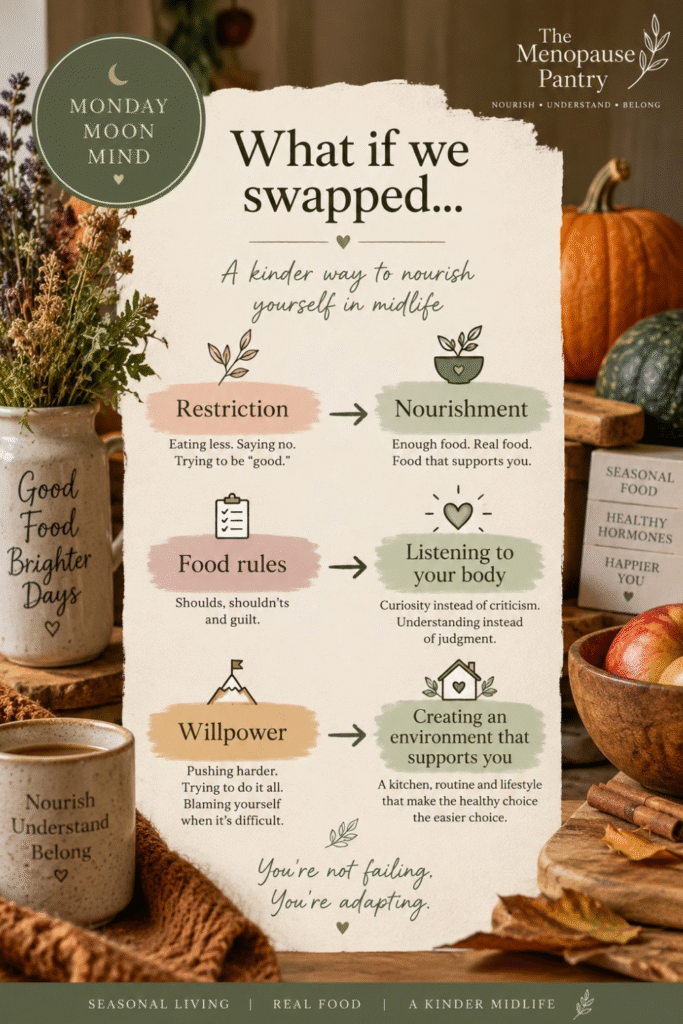
One of the things I want women to move away from in menopause is the idea that we should always be trying to eat less.
Smaller portions.
Low-calorie versions.
Skipping meals because we ate too much yesterday.
Trying to survive until lunchtime on coffee and good intentions.
Your body needs nourishment.
As autumn arrives, meals can become wonderfully substantial without becoming complicated.
Think slow-cooked meat with root vegetables. Thick bean soups finished with good olive oil. Porridge topped with stewed fruit and nuts. Baked potatoes piled with something delicious. Curries made with coconut milk, vegetables and spices.
Real food.
Enough food.
Food that leaves you feeling fed.
Nourish, don’t punish.
Bring Back the Warming Spices
This might be my favourite autumn pantry swap.
The spice cupboard comes alive again.
Cinnamon, ginger, turmeric, cumin, coriander, cardamom, cloves, nutmeg…
Suddenly the kitchen smells different.
A pinch of cinnamon transforms stewed apples.
Cumin and coriander turn lentils and tomatoes into something completely different.
Ginger can find its way into soups, curries and mugs of hot tea.
And this is where the old apothecary feel of the pantry really begins to emerge.
Herbs and spices aren’t mysterious powders that need to live in expensive supplement capsules.
They are ingredients humans have cooked with for generations.
Your kitchen can be your first apothecary.
From Quick to Slow… Sometimes
Autumn also seems to invite a different kind of cooking.
A pot bubbling on the stove.
Something roasting in the oven.
Bread proving on the side.
Broth simmering from Sunday’s chicken.
Not because we all suddenly have three spare hours every afternoon – wouldn’t that be nice – but because slower cooking can actually make life easier.
Make twice as much soup and tomorrow’s lunch is sorted.
Cook extra meat and vegetables and you have the beginnings of another meal.
Stew a pan of apples and breakfast is halfway made for several days.
This is where seasonal eating meets food resilience.
We’re not spending our lives in the kitchen.
We’re allowing the kitchen to look after our future selves.
Follow Your Curiosity
And perhaps that’s the biggest autumn swap of all.
Instead of asking:
“What am I supposed to eat in menopause?”
Try asking:
“What sounds nourishing today?”
- Something warm?
- Something crunchy?
- Something substantial?
- Something fresh?
- Something salty?
- Something comforting?
Then get curious about the answer.
Because learning to nourish yourself isn’t about replacing one set of food rules with another.
It’s about rebuilding that relationship between your body, your food and the world around you.
The wisdom of the old ways alongside what we now understand about nutrition.
A little modern science.
A little ancient wisdom.
And perhaps just a sprinkling of kitchen magic.
What Is Your Body Asking For?
This is where I think the Menopause Pantry becomes about much more than food.
Because you can have a cupboard full of lentils, a freezer full of homemade stock and enough magnesium-rich foods to feed the entire street…
But the real skill is learning to understand what your body needs from them.
Menopause symptoms don’t happen neatly one at a time.
You might be exhausted by 3pm, craving something sweet after dinner, waking in the night, feeling bloated after meals or wondering why the breakfast you’ve eaten for years suddenly doesn’t keep you satisfied until lunch.
And our instinct is often to ask:
“What should I take for that?”
- A supplement for sleep.
- Something for bloating.
- Something else for energy.
- Another thing for hot flushes.
But what if, instead of immediately trying to silence each symptom, we became curious about the signal?
What is my body trying to tell me?
Perhaps the next question isn’t “What fixes this symptom?” but:
“Which system in my body might need some support to do its job properly?”
Digestion. Blood sugar regulation. The nervous system. The gut. The liver. Thyroid function. Sleep and circadian rhythm. Our changing hormonal environment.
They’re not separate little boxes. They interact with one another, and they all require something remarkably unsexy to function:
Enough nourishment.
That’s why I don’t believe menopause nutrition begins with restriction.
It begins with making sure your body has the raw materials it needs and then paying attention to how it responds.
- Your energy.
- Your appetite.
- Your digestion.
- Your sleep.
- Your mood.
- Your cravings.
Your body is giving you information all the time.
The Menopause Pantry is simply one way we can begin responding to it.
Not by eating perfectly.
Not by diagnosing ourselves from a symptom checklist.
But by creating a nourishing environment, becoming curious about our own bodies, and slowly rebuilding the confidence to ask:
What do I need today?
An Autumn Pantry for Real Life
After all this talk of seasons, nourishment and listening to your body, your autumn pantry still has to work on a wet Wednesday evening when you’re tired, hungry and really can’t be bothered.
This is where a little preparation becomes an act of kindness to your future self.
Keep versatile ingredients around that can become something without requiring a complicated recipe.
🍅 Lentils, tomatoes and spices can become a dhal.
🫘 Beans, vegetables and stock can become soup.
🥕 Chicken and root vegetables can be thrown onto a tray and roasted.
🍏 Oats, apples, cinnamon and yoghurt can become breakfast, pudding or something in between.
And when autumn gives us an abundance of something, we can borrow another little piece of wisdom from generations before us:
Save some for later.
Freeze the glut of tomatoes from the garden. Stew apples. Dry herbs. Make chutney. Ferment vegetables. Turn the bones from your Sunday chicken into stock.
You don’t need to become Barbara from The Good Life and preserve enough food to survive until spring.
Just start somewhere.
Because every jar, portion of soup or bag of chopped vegetables you put away is one less decision your future self has to make.
And perhaps that’s where we discover that the real autumn pantry swap isn’t simply:
salad → soup
or
berries → apples.
It’s something deeper.
Rushing → preparing.
Restricting → nourishing.
Following food rules → listening to your body.
Depending on willpower → creating an environment that supports you.
“What should I eat?” → “What do I need?”
Your pantry becomes more than somewhere you store food.
It becomes part of the way you care for yourself.
A place where modern nutrition meets old kitchen wisdom, where seasonal abundance is turned into something useful, and where nourishing yourself becomes a little easier on the days when life isn’t.
Maybe that’s what our grandmothers understood that we’ve forgotten.
Knowing how to feed yourself is its own kind of wisdom.
And perhaps, in midlife, it’s time we reclaimed it.
🌙 This Week’s Moon Kitchen Recipe
Moon Phase: 🌕 Full Moon | Detox
Moon Kitchen Focus: Support natural hormone metabolism and elimination through the liver and gut with protein, fibre, cruciferous vegetables and antioxidants.
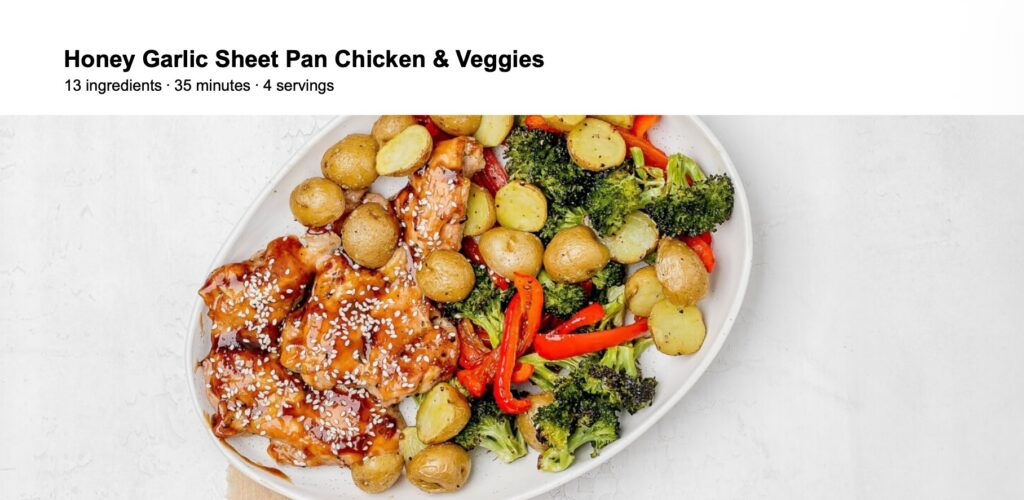
This Week’s Recipe: Honey Garlic Sheet Pan Chicken & Vegetables
The Full Moon marks the peak of the lunar cycle and mirrors the ovulatory phase, when estrogen reaches its highest point during our reproductive years.
Our focus this week is supporting the body’s own natural detoxification pathways, not through restriction, but through nourishment.
This simple sheet pan dinner combines protein-rich chicken with broccoli, red peppers and potatoes. Cruciferous broccoli provides plant compounds that support hormone metabolism, while fibre supports the gut and healthy elimination. Colourful peppers add vitamin C and antioxidants, creating a satisfying meal that gives the liver and gut plenty to work with.
And because it all cooks on one tray, it’s nourishing food made for real life.