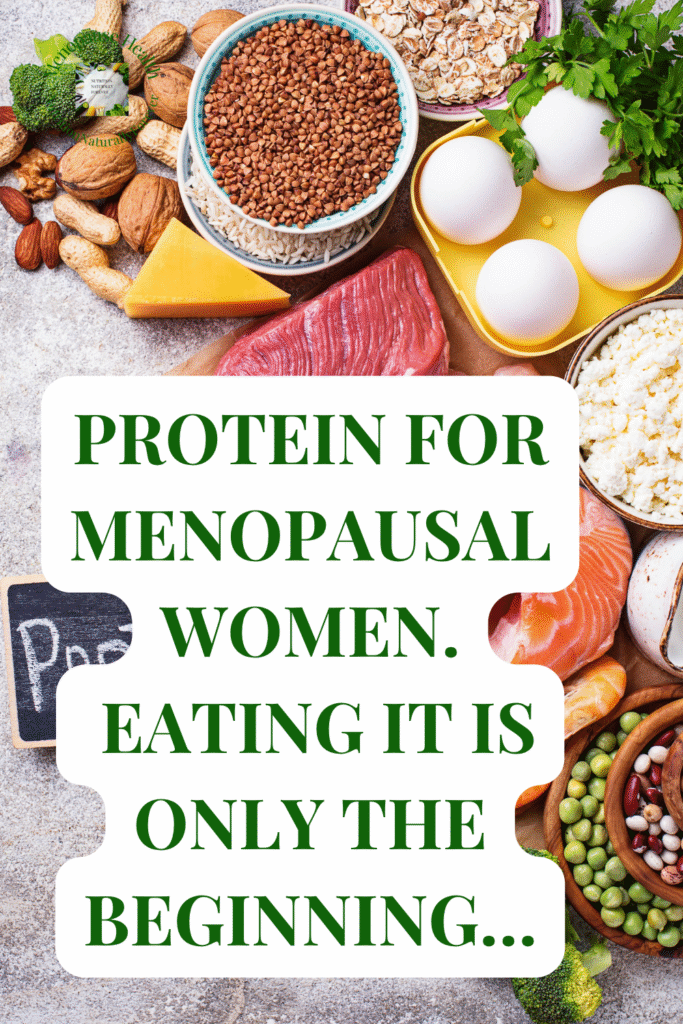
Protein for Menopausal Women: How to Build a High-Protein Menopause Pantry.
If you’ve spent any time looking for menopause nutrition advice recently, you’ve probably heard the same message over and over again:
Eat more protein.
And there’s good reason for it. Protein becomes increasingly important as we move through perimenopause and beyond, helping us maintain muscle, support our bones, recover well and provide the amino acids our bodies need for countless everyday processes.
But somewhere along the way, eat more protein seems to have become buy more high-protein products.
Walk through any supermarket and you’ll see HIGH PROTEIN splashed across yoghurts, bars, shakes, cereals, puddings, cookies and snacks, many of which are still ultra-processed foods dressed up with a rather impressive-looking protein number on the front.
We’ve taken something our bodies have always needed and turned it into another thing to count, track and buy.
But what if eating more protein isn’t the whole story?
Because putting 30g of protein on your plate doesn’t automatically mean your body can make full use of it.
Before the protein in that chicken breast, egg or bowl of Greek yoghurt can do anything useful, your body has to digest it, break it down into amino acids, absorb them and then use those building blocks where they’re needed.
And that’s the part of the protein conversation I don’t think we talk about enough.
You can keep adding more protein to your diet, but if you’re regularly bloated after meals, struggling with reflux, feeling uncomfortably full, experiencing changes in your bowels, sleeping badly or simply feeling exhausted despite trying to do everything “right”, I’d be more interested in what your body is telling you than whether you’ve hit your protein target.
Those symptoms don’t automatically mean you’re not absorbing protein, of course. But they can be valuable clues that it’s worth looking at the bigger picture;
- your digestion,
- gut,
- stress,
- sleep
- wider health
Rather than simply adding another scoop of protein powder.
That’s the approach I take to menopause nutrition.
Menopause isn’t a checklist, and protein shouldn’t become another box to tick.
So in this article, we’re going to look at why protein matters for menopausal women, what actually happens to it once you eat it, what might get in the way of your body making the most of it and how to build a high-protein Menopause Pantry using simple, real foods that have been nourishing us for generations.
No cupboard full of protein bars required.
Why Is Protein Important for Menopausal Women?
Protein matters throughout our lives, but it becomes particularly important as we move through perimenopause, menopause and into later life.
One of the biggest reasons is muscle.
From midlife onwards, we naturally begin to lose muscle mass and strength, and the hormonal changes that happen around menopause can add another layer to this. Getting enough protein, alongside using and challenging our muscles through movement and resistance exercise, helps give the body the building blocks it needs to maintain and repair muscle.
And this isn’t about trying to achieve a particular body shape.
Muscle is about future health.
It’s getting out of a chair easily, carrying your shopping, gardening, travelling, playing with grandchildren and continuing to do the things you love as you get older. Muscle also plays an important role in metabolic health and how our bodies manage glucose.
Protein can also help with satiety.
A meal containing a good source of protein tends to be more satisfying, which can help you feel fuller for longer and may help reduce the constant grazing or energy crashes that can happen when meals don’t quite sustain us.
Then there’s our bones.
We often associate bone health with calcium and vitamin D, but protein is an important part of the structure of bone too.
Maintaining muscle also matters because strong muscles, balance and physical activity all contribute to protecting our bones as we age.
But protein does far more than build muscle.
When we digest protein, we break it down into amino acids. Think of these as little building blocks that the body can use in many different ways.
They’re involved in building and repairing tissues, making enzymes and other proteins, supporting immune function and producing important signalling molecules.
And this is where protein becomes much more interesting to me than simply asking:
“How many grams have I eaten today?”
Because two women could eat exactly the same chicken breast containing exactly the same amount of protein.
What matters next is what their bodies are able to do with it.
And to understand that, we need to follow that chicken breast a little further…
Eating Protein Isn’t the Same as Being Able to Use It
So, let’s go back to those two chicken breasts.
On paper, they contain the same amount of protein. But your body can’t simply take the protein from your dinner and send it straight to your muscles.
First, it has to break it down.
Protein digestion begins in your stomach, where stomach acid helps unfold the protein structure and enzymes begin breaking it into smaller pieces.
From there, your food moves into the small intestine, where enzymes released by the pancreas continue the job, breaking those proteins down into smaller peptides and individual amino acids.
Those amino acids can then be absorbed through the wall of the small intestine and enter circulation, where they become available for your body to use.
And this is why I think focusing only on how many grams of protein are on your plate misses something rather important.
What actually happens to that chicken breast?
Let’s take just one of the amino acids found in chicken: tryptophan.
Tryptophan is an essential amino acid, which means your body can’t make it for itself. You have to obtain it through your diet.
Once protein has been digested and tryptophan becomes available to the body, it can be used in a pathway that produces serotonin. Serotonin can then be used to make melatonin, a hormone involved in regulating our sleep-wake cycle.
So, very simply:
Chicken → protein → amino acids → tryptophan → serotonin → melatonin
Now, I’m not suggesting that eating a chicken breast for dinner is going to magically fix your menopause insomnia!
The process is much more complex than that, and sleep is influenced by everything from hormones and stress to light exposure, blood sugar, alcohol, caffeine and our daily rhythms.
But I love this example because it demonstrates something we often forget when we reduce food to calories, macros or grams of protein.
Food provides your body with raw materials.
And your body still has to access them.
Suddenly, that chicken breast isn’t simply “30 grams of protein”.
It’s a collection of amino acids that your body can potentially use to maintain muscle, repair tissue, make enzymes and support many of the processes happening inside you every single day.
Which brings us back to those two women eating exactly the same meal.
One might eat her chicken, digest it comfortably, absorb the nutrients and carry on with her day.
The other might finish the same meal feeling bloated, refluxy, painfully full or uncomfortable.
Perhaps she’s constipated. Perhaps her bowels are unpredictable. Perhaps she’s exhausted, stressed and eating dinner standing at the kitchen counter because she’s spent the entire day rushing around looking after everyone else.
Same chicken. Same protein on paper. Very different body receiving it.
And that’s why, before we automatically tell every menopausal woman to simply eat more protein, I think we need to ask another question:
What if your body is telling you that it needs support to make the most of the protein you’re already eating?
What If You’re Eating Plenty of Protein But Don’t Feel Better?
This is where I want you to forget about protein targets for a moment and think about you.
Maybe you’ve already made an effort to eat more protein.
You’ve added eggs at breakfast, chicken or fish at lunch, Greek yoghurt as a snack. Perhaps you’ve even started adding protein powder to your smoothie because everywhere you look you’re being told you need more.
But how do you actually feel?
Do you regularly experience:
- bloating or discomfort after eating?
- reflux or indigestion?
- feeling unusually full or heavy after meals?
- constipation, loose stools or unpredictable bowel movements?
- lots of wind or burping?
- poor appetite or finding larger protein-rich meals difficult to eat?
- tiredness after meals?
- low energy despite feeling as though you’re eating well?
- poor sleep and recovery?
- difficulty maintaining your strength and muscle despite making an effort with protein and movement?
None of these symptoms automatically means you’re not digesting or absorbing protein properly.
And they certainly aren’t a diagnosis.
But they are information.
This is where I think we’ve become disconnected from something incredibly valuable.
We are so used to looking outside ourselves for the answer that we can forget to notice what is happening inside our own bodies.
- We track calories.
- We count protein.
- We buy supplements.
- We follow somebody else’s meal plan.
- We Google our symptoms.
And increasingly, we’re encouraged to test everything from our gut and thyroid to our hormones and nutrient levels.
Some of those things can be incredibly useful.
But before we add another number, test or protocol, what if we simply became curious about what our body is already telling us?
Your symptoms are signals, not something to silence
Bloating is information.
Reflux is information.
Your bowel movements are information.
Your appetite is information.
Your energy is information.
How you feel after eating is information.
Your sleep is information.
Even noticing that you digest the exact same meal differently when you’re relaxed compared with when you’re rushing or stressed is information.
None of those things tells us, on its own, exactly what is happening inside your body.
But together they can begin to create a picture.
And instead of immediately asking:
“What should I take for this?”
I want women to become comfortable asking:
“What might my body be asking me to pay attention to?”
Because perhaps the answer isn’t another 20 grams of protein.
Perhaps we need to look at..
- Your digestion.
- Your gut.
- Your stress and nervous system.
- Your sleep.
- Your blood sugar.
- Your wider health.
This is the difference between following generic menopause nutrition advice and learning how to nourish your body through menopause.
And it’s exactly why my approach doesn’t start with another checklist.
It starts with understanding the woman eating the chicken.
What Could Be Getting in the Way of Digesting and Using Protein?
Let’s return to our chicken one more time.
For your body to access those amino acids, several things need to happen along the way.
Digestion isn’t one isolated event in your stomach; it’s a process involving your digestive system, nervous system, hormones, enzymes, gut and wider metabolic health.
Which means there isn’t always one simple answer when something doesn’t feel quite right.
It starts before you even swallow
Digestion actually begins before food reaches your stomach.
Seeing, smelling and anticipating food can start preparing your digestive system for what’s coming.
Then chewing physically breaks food down and mixes it with saliva before it travels to the stomach.
It sounds ridiculously simple, but think about how many of us actually eat.
- Standing at the kitchen counter.
- Checking our phones.
- Driving between appointments.
- Eating while working.
- Wolfing down dinner because we’re exhausted and just want to get everything cleared away.
How you eat matters as well as what you eat.
Your stomach has a job to do
Once that chicken reaches your stomach, stomach acid helps unfold the proteins and creates the conditions needed for enzymes such as pepsin to begin breaking them down.
The partially digested food then moves into the small intestine, where pancreatic enzymes continue the process.
If you’re regularly experiencing reflux, bloating, uncomfortable fullness, nausea or feeling that food sits heavily after eating, that doesn’t tell us exactly what is happening.
But it does give us a reason to pay attention to digestion, rather than assuming the answer is simply to add more food or protein.
Your gut matters too
The small intestine is where much of the absorption of amino acids takes place.
So gut health isn’t simply about whether you feel bloated.
The digestive tract is the interface between the food you eat and the nutrients your body ultimately gets access to.
Conditions affecting the stomach, pancreas or small intestine can interfere with digestion or nutrient absorption, which is also why persistent or unexplained digestive symptoms deserve proper medical investigation rather than being dismissed as “just menopause”.
But for many women, there are also everyday clues we can begin noticing long before reaching for an expensive private gut test.
- How regularly are you opening your bowels?
- How do you feel after eating?
- Are certain meals repeatedly uncomfortable?
- Has your digestion changed?
- Are you actually hungry at mealtimes?
- What patterns can you see?
Again, we’re not trying to diagnose ourselves.
We’re learning to notice.
Your nervous system comes to the dinner table too
This is one of the pieces of nutrition I think we massively underestimate.
You don’t leave your stressful day at the kitchen door.
If you’ve spent all day rushing, worrying, working, caring for other people and running on adrenaline, you bring that state to the table with you.
Your autonomic nervous system helps regulate digestive processes, which is why the familiar phrase “rest and digest”exists.
This doesn’t mean stress somehow switches digestion off completely.
But chronic stress can affect appetite, gastrointestinal movement and digestive symptoms, and it can change the way we eat too.
Perhaps you’re eating quickly.
Skipping meals.
Not chewing properly.
Reaching for whatever is easiest because you’re exhausted.
Or eating dinner while mentally running through tomorrow’s to-do list.
Suddenly, we’re a long way from simply asking whether your chicken contained enough protein.
Sleep, blood sugar and metabolic health are part of the picture
And then we have the knock-on effects.
Poor sleep can influence appetite, food choices, energy, recovery and how the body manages glucose.
Blood-sugar regulation can affect hunger, energy and cravings.
Muscle itself plays an important role in metabolic health.
Movement influences muscle.
Stress influences sleep.
Sleep influences appetite.
What we eat influences all of them.
Everything is connected.
This is why I don’t believe menopause nutrition works particularly well when we pull one nutrient, one symptom or one hormone out of the body and try to “fix” it in isolation.
Your body isn’t a collection of separate departments.
It’s a whole system.
And sometimes the most useful question isn’t:
“How can I get more protein?”
It’s:
“Where might my body need support so that it can make better use of the nourishment I’m already giving it?”
Do You Need a Test to Understand What Your Body Needs?
At this point you might be thinking:
“How on earth am I supposed to know which part of my body needs support?”
- Do I need a gut test?
- Should I test my hormones?
- What about my thyroid?
- My liver?
- My vitamin and mineral levels?
There are tests available for almost everything, and some of them can be incredibly useful.
I’m not anti-testing.
If your symptoms suggest that something needs investigating, appropriate medical testing can be important.
Blood tests and other investigations can help diagnose or rule out health conditions, identify deficiencies and give your doctor valuable information about what’s happening inside your body.
There may also be occasions when additional private testing provides useful information.
But I don’t believe every woman needs to spend hundreds, sometimes thousands, of pounds testing every system in her body before she can begin supporting herself.
And I certainly don’t want women to believe they can’t understand their bodies without a laboratory report telling them what’s going on.
A test gives us data. Often, very useful data.
But depending on what is being measured, it may also represent one particular marker at one particular moment in time.
Your body, on the other hand, is giving you information every single day.
- How did you sleep last night?
- How hungry were you when you woke up?
- Did breakfast keep you satisfied until lunch?
- Did your energy crash at 3pm?
- Did that meal leave you comfortably full or painfully bloated?
- How are your bowels?
- Are you craving something sweet every evening?
- Do you feel completely different after a good night’s sleep?
- Does your digestion change during stressful periods?
- What happens when you eat slowly and sit down compared with grabbing something on the run?
None of those observations gives you a diagnosis.
But over days, weeks and months, patterns begin to emerge.
And learning to recognise those patterns is powerful.
Body literacy before another protocol
This is something I want more women to have.
Not another list of menopause symptoms to tick off.
Not another app telling you whether you’ve been “good” today.
Not another expensive test followed by a complicated protocol that leaves you wondering what you’re supposed to eat.
Body literacy.
The ability to notice what’s happening in your own body, understand some of the systems that might be involved and make nourishing changes while observing how your body responds.
I think of it as:
Notice → Understand → Nourish → Observe → Adjust
Maybe you notice that your digestion is much worse when you’re stressed.
Maybe breakfast containing protein, fibre and healthy fats leaves you feeling completely different from the breakfast you’ve eaten for the last twenty years.
Maybe you realise you’re sleeping badly on the days you’ve barely eaten enough.
Maybe your afternoon energy improves when lunch actually sustains you.
Maybe slowing down and sitting at the table changes how you feel after a meal.
These aren’t laboratory results.
They’re your results.
And when you begin collecting that information, you start building something far more useful than another set of rules.
You start building a relationship with your body.
And sometimes your body tells you it’s time to get help
Understanding your body doesn’t mean trying to fix everything yourself.
In fact, I think body literacy should help you recognise when something doesn’t feel right.
Persistent digestive symptoms, unexplained weight loss, difficulty swallowing, blood in your stools, persistent vomiting, significant changes in bowel habits or other new or concerning symptoms aren’t things to simply “nourish your way through”.
That’s when listening to your body means taking those signals to an appropriate healthcare professional and asking for them to be investigated.
And body literacy can be incredibly valuable in that room too.
Instead of only being able to say:
“I just don’t feel right.”
You may be able to explain:
- This started three months ago.
- It happens particularly after I eat.
- I’ve noticed this change in my bowel habits.
- This is different from what’s normal for me.
- I’ve tried changing this and the symptom hasn’t improved.
- It’s happening four or five times a week.
That gives your doctor much more useful information to work with and helps you ask more specific questions about what might need investigating.
And importantly, it can give you more confidence to say:
“I know menopause can cause changes, but this is new for me and I’d like it investigated rather than assuming it’s menopause.”
Because while menopause can explain an enormous number of changes in the body, being a menopausal woman doesn’t mean every symptom should automatically be attributed to menopause.
Testing and body awareness aren’t opposing approaches.
They can work beautifully together.
The difference is that I don’t want you to feel dependent on a test for every decision you make about your health.
I want you to know your own baseline.
To notice when something changes.
To understand enough about your body to ask better questions.
And to know when you can make a simple nourishing adjustment and when it’s time to ask for more help.
Because ultimately, the goal isn’t to become your own doctor.
It’s to become an expert in living in your own body.
How to Build a High-Protein Menopause Pantry
So now we understand a little more about the body receiving the protein, let’s get practical.
Because despite everything we’ve just explored, protein is still incredibly important during menopause.
And getting more of it doesn’t require an entirely new diet.
You don’t need to start eating chicken breasts out of Tupperware.
You don’t need to weigh every meal.
And you definitely don’t need to replace half the contents of your kitchen with foods shouting HIGH PROTEIN at you from the packet.
You can start with ordinary, real food.
Start with the food you already recognise
Look around your kitchen and you probably already have the beginnings of a high-protein Menopause Pantry.
In the cupboard, that might be tinned fish, lentils, beans, nuts, seeds and nut butter.
In the fridge, eggs, Greek yoghurt, cottage cheese, meat, fish and those useful leftovers from yesterday’s dinner.
And don’t forget the freezer. Chicken, fish, prawns, minced meat and portions of batch-cooked chilli, casseroles and soups can make you a future friend to yourself.
You don’t need all of them.
The point isn’t to create another enormous shopping list.
It’s to keep a small collection of foods you actually enjoy eating that make putting a useful source of protein onto your plate easier.
Because the best Menopause Pantry isn’t the one that looks perfect on Instagram.
It’s the one that feeds you on a Wednesday night when you’re tired, hungry and really can’t be bothered.
Think in meals, not isolated protein foods
And this is important.
I don’t want you to finish this article thinking every meal now needs to revolve around chasing the biggest possible protein number.
Think about the whole plate.
That chicken could sit alongside lentils, roasted seasonal vegetables, herbs and olive oil.
Your Greek yoghurt could have berries, nuts and seeds.
Eggs could become an omelette filled with leftover vegetables and served with a slice of sourdough.
Tinned salmon could become fishcakes, be stirred through a salad or added to a jacket potato.
Beans could become a warming autumn chilli with minced beef, tomatoes and spices.
Protein works as part of nourishment, not instead of it.
That’s the Menopause Pantry approach.
We aren’t collecting individual “superfoods”.
We’re learning how to keep useful ingredients around us and turn them into meals that support the whole body.
You Don’t Need a Cupboard Full of Protein Bars
There is something slightly strange about the way we’ve turned protein into a product.
- Protein bars.
- Protein cookies.
- Protein puddings.
- Protein cereal.
- Protein shakes.
Foods that often bear very little resemblance to the ingredients they started with, but somehow acquire a health halo because 20G PROTEIN has been printed across the front of the packet.
Many of these are ultra-processed foods, and while eating one occasionally isn’t going to undo an otherwise nourishing diet, you don’t need them in order to eat enough protein.
Some of the most useful protein foods have been sitting in ordinary kitchens for generations.
- Eggs.
- Fish.
- Meat.
- Yoghurt.
- Cheese.
- Lentils.
- Beans.
- Nuts.
- Seeds.
There isn’t anything particularly sexy about a tin of sardines or a bowl of lentils.
They don’t need clever packaging.
They don’t need a menopause label.
And they certainly don’t need to cost £3 for a single serving.
They’re just food.
That’s something I want The Menopause Pantry to bring us back to.
Not perfection.
Not restriction.
Not fearing every packaged food.
Just recognising that before the food industry convinced us we needed a specialist product for every nutritional requirement, women already knew how to nourish themselves from their kitchens.
Sometimes modern nutrition can simply help us understand why that old wisdom worked.
Want to make this practical in your own kitchen?
I’ve created The Menopause Pantry Protein Guide to help you do exactly that.
Inside you’ll find real-food protein ideas for your cupboard, fridge and freezer, realistic portion examples, simple ways to turn them into meals and a printable Protein Pantry checklist.
No complicated meal plan. No obsessing over numbers. No cupboard full of protein bars.
GET THE FREE PROTEIN GUIDE →
Your Menopause Pantry Should Support the Body That Has to Use It
We’ve covered a lot of ground from one chicken breast.
And perhaps that’s the point.
Because when we reduce menopause nutrition to:
“Eat more protein.”
we miss the woman eating it.
Yes, protein matters.
Yes, I want you to have good sources of protein in your kitchen.
And yes, there may be times when deliberately increasing the amount you eat is exactly what your body needs.
But I don’t want protein to become another menopause rule you feel you’ve failed if you don’t hit the right number.
I want you to understand why you’re eating it.
To recognise the raw materials that real food provides.
To notice how your body responds.
To become curious when something doesn’t feel right.
And to know that nourishment is about far more than what appears on a nutrition label.
This is what The Healthy Menopause and The Menopause Pantry are ultimately about.
Understand your body. Know how to nourish it.
Your pantry gives you the ingredients.
Your body gives you the information.
And the more you learn to bring those two things together, the less dependent you become on the latest diet, protein product, supplement, test or menopause checklist telling you what you “should” be doing.
You begin to notice.
To understand.
To nourish.
To observe.
To adjust.
And perhaps most importantly, to trust yourself again.
🌙 This Week’s Moon Kitchen Recipe
Moon Phase: 🌓 First Quarter | Build
Moon Kitchen Focus: Build and nourish your gut microbiome with fermented foods, fibre, colourful plants and diversity.
This Week’s Recipe: Chocolate & Berry Kefir Smoothie
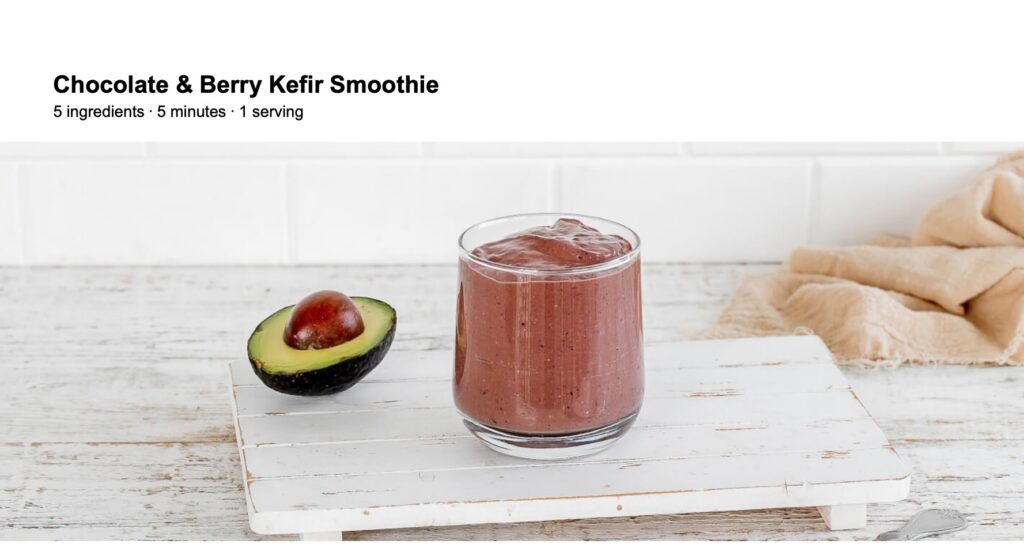
As the First Quarter Moon arrives, our focus shifts from restoring to building. Mirroring the follicular phase of the menstrual cycle, this is our reminder to nourish the gut microbiome, an important part of digestion, nutrient absorption and healthy hormone metabolism throughout perimenopause and beyond.
This Chocolate & Berry Kefir Smoothie combines probiotic-rich kefir with berries, avocado and chia seeds. The kefir introduces beneficial bacteria, while fibre and plant compounds from the other ingredients help feed the microbes already living in your gut.
It’s a simple way to bring fermented food, fibre and greater plant diversity into your day and proof that supporting your gut can taste like chocolate!
👉 Make the recipe.