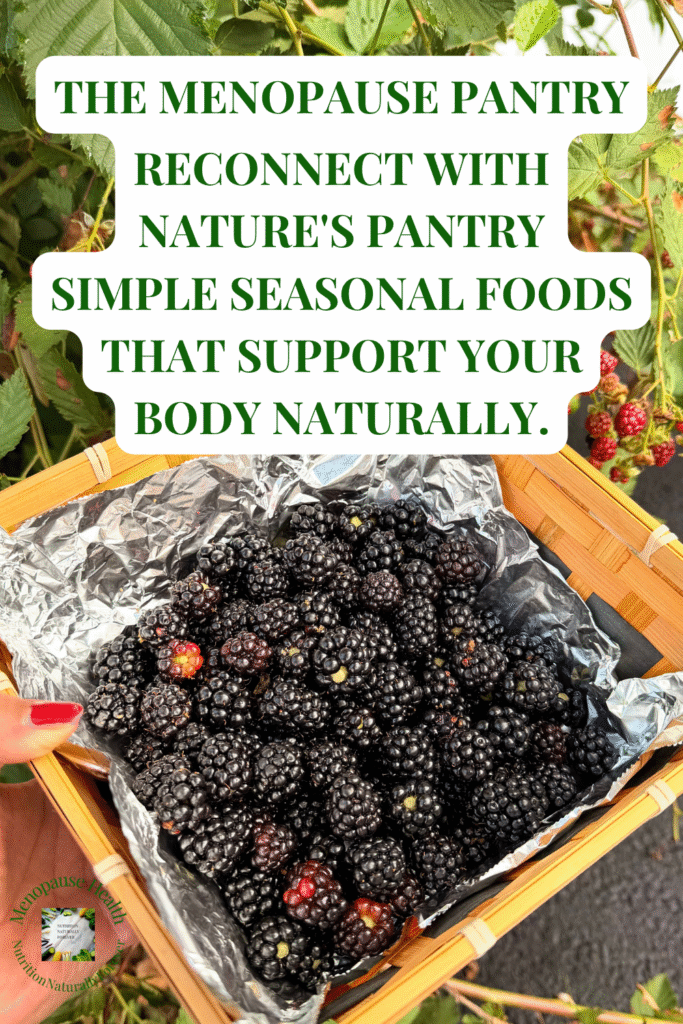
The Menopause Pantry: Reconnecting With Nature’s Pantry.
I wonder how many times you’ve walked past a blackberry bush without really seeing it.
Or driven past an apple tree so heavy with fruit that the branches almost touched the ground.
Perhaps you’ve admired the frothy white elder flowers in spring, never realising they would become deep purple elderberries by late summer. Maybe you’ve caught the scent of wild herbs growing along a footpath, but never stopped to pick a leaf.
The truth is, we’ve become surrounded by food we no longer recognise.
For thousands of years, people lived in tune with the seasons. They knew when the blackberries would ripen, where the hazelnuts grew, when the apples were ready to pick and how to preserve the abundance that nature provided. It wasn’t called foraging. It was simply part of everyday life.
Somewhere between supermarkets, convenience foods and year-round availability, we stopped paying attention. We lost the habit of looking beyond the supermarket shelves and forgot that nourishment has always been growing around us.
And perhaps that’s why this feels so important during menopause.
So many women tell me they feel disconnected.
- From their bodies,
- From their energy,
- From their confidence and even
- From the joy they once found in everyday life.
We search for the next supplement, the next super food or the next miracle solution, when sometimes the greatest gift is simply slowing down enough to notice what has been there all along.
Because the Menopause Pantry doesn’t just begin when you open your kitchen cupboard.
It can begin when you step outside your front door.
This isn’t about becoming an expert forager or living off the land.
It’s about reconnecting with the seasons, becoming curious again and remembering that nature has always provided incredible foods that nourish our bodies.
Whether it’s filling a bowl with blackberries on a summer walk, collecting windfall apples from a neighbour’s garden or drying herbs from your windowsill, these small acts reconnect us to something we’ve quietly been missing.
And perhaps, in the process of rediscovering nature’s pantry, we begin to rediscover ourselves too.
We Once Knew Nature’s Pantry
There was a time when we didn’t need books, apps or social media to tell us what was in season.
We simply knew.
Children grew up recognising blackberry bushes on their walk home from school. Families picked apples from the garden or the local orchard. Elderberries became warming winter cordials, herbs were gathered from the garden, and preserving the summer harvest wasn’t a hobby, it was simply how you made sure there was enough to eat when winter arrived.
Our grandmothers didn’t have “super foods.”
They had whatever the season, nature’s pantry, offered.
They understood that raspberries belonged to summer, blackberries arrived as the evenings began to cool, and rose-hips appeared when autumn was quietly announcing its arrival.
Food wasn’t expected to be available every day of the year, and because of that, each season brought something to look forward to.
Today, we’ve gained incredible convenience, but perhaps we’ve lost something too.
We can buy strawberries in December, asparagus in October and herbs sealed inside plastic packets without giving a second thought to where they’ve come from or how far they’ve travelled.
Somewhere along the way, our connection to the seasons became disconnected from our plates.
The hedgerows became part of the scenery instead of part of the pantry.
Perhaps that’s one reason so many of us feel disconnected during menopause.
Nature has never stopped following its rhythms.
The moon still waxes and wanes. The seasons still change. The blackberry bushes still ripen every August.
Maybe we’ve simply stopped noticing.
And perhaps reconnecting with our food starts not by buying something new, but by remembering what we’ve known all along.
Menopause Doesn’t Need More Noise
One of the things I hear most often from women is how overwhelming menopause has become.
Every day there’s another expert telling us to eat a different way.
Another supplement we must buy.
Another list of foods to avoid.
Another miracle ingredient promising to fix everything.
It’s exhausting.
What if, instead of constantly searching for the next answer, we simply became more present with what is already here?
There’s something wonderfully grounding about walking through a field or along a hedgerow and noticing the seasons changing around you.
The first blackberries appearing.
The scent of wild fennel warming in the sunshine.
The elderberries beginning to darken.
The apples slowly becoming heavy on the branches.
Nature isn’t in a hurry.
It doesn’t rush from one season to the next.
It doesn’t compare itself to anyone else.
It simply follows its own rhythm.
Perhaps that’s one of the greatest lessons menopause has to teach us too.
For years we’ve lived by the clock.
Working.
Rushing.
Looking after everyone else.
Ignoring the signals our bodies have been quietly sending us.
Then menopause arrives, and suddenly our bodies ask us to slow down.
- To rest.
- To nourish ourselves more deeply.
- To spend more time outside.
- To reconnect with the natural rhythms we’ve been living apart from for so long.
Maybe that’s why a simple blackberry walk can feel surprisingly healing.
Not because blackberries are a miracle food, although they are wonderfully rich in fibre, vitamin C and protective plant compounds, but because picking them asks us to do something we rarely do anymore.
Slow down.
Look around.
Notice.
Reconnect.
Sometimes the greatest nourishment isn’t just what we bring home in the basket.
It’s who we become while we’re filling it.
Nature’s Menopause Pantry
One of the easiest ways to begin reconnecting with nature is simply to know what’s growing around you.
You don’t need to become an expert overnight.
In fact, I’d encourage you not to. Learn one plant, one berry or one herb at a time and enjoy the process of becoming more observant.
Before long, you’ll start noticing that nature quietly provides something new with every passing week.
If you’re reading this in late summer, you’ll discover that nature’s pantry is wonderfully abundant.
🫐 Blackberries (August-September)
One of the easiest wild foods to recognise and collect.
Rich in fibre, vitamin C and colourful plant compounds called anthocyanins, blackberries are wonderful for supporting gut health, immune function and protecting our cells from oxidative stress. I freeze bags of them to enjoy in, yoghurt, overnight oats and crumbles throughout the winter.
🍎 Wild Apples & Crab Apples (August–October)
Often overlooked, wild apples make delicious crumbles, chutneys and preserves.
They’re a fantastic source of fibre, particularly pectin, which helps nourish our gut bacteria and supports healthy digestion, something many women notice changes during menopause.
🟣 Elderberries (August-September)
One of my absolute favourites.
I turn mine into elderberry rob and cordials to enjoy through the colder months. Elderberries have been treasured for generations and are naturally rich in antioxidants that support the immune system. Just remember that raw elderberries shouldn’t be eaten and should always be cooked before using.
💙 Sloes (September-October)
Every autumn I head out to collect sloes, filling bags to pop straight into the freezer.
Traditionally, the first frost was said to soften the fruit, but freezing does exactly the same job, splitting the skins and allowing their beautiful flavour to infuse more easily. Mine become homemade sloe gin, ready to enjoy around the Winter Solstice and Christmas, a little seasonal tradition I look forward to every year.
Sloes are far too sharp to eat straight from the bush, but with a little patience they become something rather special.
🌹 Rosehips (September-November)
As summer fades, the bright red rose-hips begin to appear.
Packed with vitamin C, they make wonderful syrups, teas and jellies, reminding us that even as one season comes to an end, another begins offering its own nourishment.
🌰 Hazelnuts (August-October)
If you’re lucky enough to spot a hazel tree before the squirrels do, you’ll find fresh hazelnuts tucked inside their leafy green husks.
They’re rich in healthy fats, vitamin E and minerals, making them a lovely seasonal snack or addition to baking once dried.
Nature has a wonderful way of staggering its harvest.
As the tomatoes begin to finish in the garden, the hedgerows begin to fill.
As one season gently closes, another quietly opens.
Perhaps that’s exactly how we were designed to eat, not expecting everything all year round, but looking forward to the gifts each season brings.
A Gentle Reminder About Foraging in Nature’s Pantry
Foraging should always begin with respect, for nature, for wildlife and for the people who own the land.
Only ever pick something if you are 100% confident you’ve identified it correctly. If you’re unsure, leave it where it is.
Take only what you’ll use, leaving plenty behind for birds, insects and other wildlife. A good guide is the “one for me, plenty for nature” approach. Harvest lightly so the plants continue to thrive and others can enjoy them too.
If you’re foraging on private land, always ask the landowner’s permission first. Even when you’re walking on public footpaths or access land, the land itself is usually privately owned, and you should never climb fences, enter crops or pick without permission. It’s also important to avoid protected nature reserves and Sites of Special Scientific Interest, where collecting plants or fruit may not be permitted.
Finally, forage away from busy roads, industrial areas and places that may have been sprayed with pesticides, and remember that some plants and fungi have poisonous lookalikes. When in doubt, leave it out.
Foraging isn’t about filling your freezer in one afternoon.
It’s about becoming more observant.
Walking a little slower.
Learning the rhythm of the seasons.
And remembering that sometimes the greatest abundance has been growing around us all along.
The Forgotten Pantry
I sometimes wonder if we’ve forgotten more than recipes.
When did hedgerows become something we simply drove past instead of something we stopped to admire?
When did herbs become little plastic packets instead of something growing outside the back door?
When did homemade elderberry rob become another bottle of cold and flu medicine?
When did blackberry picking become something we did as children rather than something we still make time for today?
We’ve become incredibly good at making life convenient.
But perhaps convenience has come at the cost of connection.
Connection to our food.
Connection to the seasons.
Connection to the simple satisfaction of gathering something with our own hands.
Maybe that’s one of the unexpected gifts of menopause.
It encourages us to question the way we’ve always done things.
To slow down.
To spend more time outside.
To find joy in simpler pleasures.
To rediscover skills that were never really lost… only forgotten.
Because this isn’t about turning back the clock.
It’s about taking the best of what previous generations knew and bringing it into modern life.
Simple Ways to Begin
You don’t need to head off into the countryside with baskets and field guides to get started.
Instead, try just one small thing this week.
• Notice what is growing on your daily walk.
• Pick a handful of blackberries and freeze them for winter breakfasts.
• Ask a neighbour if you can collect the apples they aren’t using.
• Make your first batch of elderberry rob or blackberry crumble.
• Dry a few herbs from your own garden or windowsill.
• Visit a local Pick Your Own farm if foraging feels a little daunting.
Small acts soon become seasonal traditions.
Before long you’ll find yourself looking forward to blackberry season, watching for the first elderberries to ripen and wondering if this year’s apples will make a better crumble or chutney.
That’s how reconnection begins.
Not with perfection.
But with paying attention.
Bringing Nature’s Pantry Back Into Your Menopause Pantry
The Menopause Pantry isn’t simply about stocking healthy menopause ingredients.
It’s about changing the way we think about food.
Learning to eat with the seasons.
Cooking more from scratch.
Making use of what’s growing around us.
Building a kitchen that nourishes not just our hormones, but our relationship with food itself.
If this way of eating speaks to you, I’d love to invite you to download my free Menopause Pantry Guide
Inside, I’ll show you how to build a nourishing pantry using simple, real foods that support your hormones naturally, without restriction, expensive super foods or complicated meal plans.
Because sometimes the healthiest changes don’t begin in the supermarket.
They begin with a walk… and a blackberry bush you’ve passed a hundred times before.
🌙 This Week’s Menopause Moon Kitchen Recipe
Moon Phase: 🌓 First Quarter | Build
Moon Kitchen Focus: Nourish your gut microbiome with probiotics, fibre and a diverse range of colourful plants.
This Week’s Recipe: Creamy Kimchi Dip
As energy begins to build during the First Quarter Moon, it’s the perfect time to strengthen the foundations of your health from the inside out. One of the most powerful ways to do that is by supporting your gut microbiome, which plays an important role in digestion, immunity and hormone health.
This creamy kimchi dip combines fermented kimchi and Greek yogurt with healthy fats to create a simple, delicious way to enjoy more probiotic-rich foods. Pair it with a colourful selection of seasonal vegetables to increase plant diversity and fibre, helping your beneficial gut bacteria thrive.