A Menopause Pantry Isn’t About Stockpiling. It’s About Resilience.
I saw a post recently about building better food resilience at home – not panic buying or stockpiling, just being a little better prepared for the times when life doesn’t quite go to plan.
And it immediately took me back to the beginning of Covid.
Remember the panic buying?
People were filling trolleys with pasta, tins and, for reasons I still don’t entirely understand, enough toilet roll to see them through the apocalypse.
I deliberately refused to join in.
I went about my usual shopping, then a few weeks later we needed toilet paper.
By this time there wasn’t a single roll to be found anywhere. I eventually went to Costco and bulk-bought boxes of tissues instead, which is how we ended up with tissue boxes sitting in our bathrooms for what felt like months. 😂
But that memory came back to me because there is an important difference between panic buying because you’re frightened of running out and quietly making sure you have what you need.
And it got me thinking about The Menopause Pantry.
The Menopause Pantry was never about having perfectly organised cupboards or buying every so-called “menopause superfood” you can find.
It’s about making it easier to nourish yourself when you’re too tired to think about what to eat.
It’s about having useful ingredients at home so you don’t have to keep popping to the supermarket because you’re missing the one thing a recipe calls for.
It’s about learning how to turn simple, affordable ingredients into nourishing meals, becoming more confident in the kitchen and knowing that you can feed yourself and your family well without spending a fortune or constantly relying on someone else to make it easier for you.
And the more I thought about it, the more I realised that this is food resilience too.
Not stockpiling.
Not preparing for disaster.
Just creating a kitchen that supports you when life doesn’t quite go to plan.
When you’ve slept badly, you’re exhausted, it’s pouring with rain and you absolutely cannot face going to the supermarket, you can still make something nourishing.
When the fridge looks a bit bare, you know how to combine what you’ve got.
When you don’t have the exact ingredient a recipe asks for, you have the confidence to improvise.
You’re creating an environment that supports you on the days when your energy and capacity are low, rather than expecting yourself to summon more willpower.
And perhaps most importantly, there’s a quiet confidence that comes with knowing:
I’ve got this. I can feed myself well with what I have.
Because a well-stocked Menopause Pantry isn’t about preparing for the worst.
It’s about being better prepared for real life.
What Does Food Resilience Actually Mean in Midlife?
When we hear the words food resilience, it’s easy to imagine emergency supplies, overflowing cupboards and preparing for some kind of crisis.
That’s not what I’m talking about.
For me, food resilience is much more ordinary than that.
It’s looking in the cupboard at 6pm and knowing you can make dinner from what’s there.
It’s having a few staples in the freezer for the week when everything goes wrong.
It’s knowing that if you don’t have an ingredient, you can swap it for something you do have.
It’s making soup from yesterday’s leftovers, freezing the glut of tomatoes from the garden or turning a bag of slightly sad apples into a crumble rather than throwing them away.
It’s capability, not catastrophe.
And I think there’s something particularly powerful about rediscovering that capability in midlife.
For years, women have been sold convenience as the answer to an increasingly busy life.
We’re surrounded by products designed to help us save time, stay organised, feed the family, keep the house running and somehow continue doing everything expected of us.
There’s nothing wrong with convenience; I certainly don’t think we need to make everything from scratch or spend our lives tied to the kitchen.
But I do think menopause can become a point at which we start questioning some of the things we’ve been sold.
Do I actually need this?
Is this making my life easier?
Could I make this myself?
Could I use what I already have?
And perhaps the biggest question:
Who decided I needed to do all of this in the first place?
This is one of the things I love about midlife.
It can become our no-BS era.
We don’t need another diet telling us what we’re allowed to eat. We don’t need a cupboard full of expensive “menopause foods”. We don’t need to be sold another product promising to make us healthier, thinner, more organised or better at keeping all the plates spinning.
We can start taking charge again.
Not by doing more, but by becoming more confident with what we already have.
A resilient Menopause Pantry won’t look the same in every home. It isn’t a perfect checklist.
It’s simply an environment that makes nourishing yourself easier – supported by a growing confidence that you know how to look after yourself.
Your Pantry Becomes More Powerful When You Understand Your Body
Of course, having the ingredients is only part of it.
The real shift happens when you begin to understand why you might choose them.
One of the things I want women to move away from in menopause is constantly asking:
What am I supposed to eat?
And start asking:
What might my body be asking for?
Because menopause symptoms don’t happen in isolation.
That afternoon energy crash, waking at 3am, feeling hungry an hour after eating, bloating after meals, changes around your middle, feeling wired but exhausted or simply not feeling like yourself can all give us useful clues about where the body might need more support.
Sometimes we might need to look at blood sugar balance.
Sometimes it’s the gut.
Sometimes we need to think about how we’re supporting the liver.
And sometimes the most nourishing thing we can do is stop trying to eat “perfectly”, make life simpler and take some pressure off an already overloaded nervous system.
This is why The Menopause Pantry isn’t a list of foods that every menopausal woman should eat.
It’s a way of creating options.
When you begin to understand what your body is telling you, you can look at the food you already have and know how to respond.
Need something that will keep blood sugar steadier? You have protein, fibre and healthy fats you can build a meal around.
Want to support your gut? There are fibre-rich plants and perhaps some fermented foods you can reach for.
Thinking about liver support? Your pantry, fridge and freezer can provide colourful vegetables, herbs, spices and nourishing whole foods to work with.
Completely exhausted and overwhelmed?
You can make the simplest nourishing meal possible and call that enough.
That’s the outcome I’m interested in.
Not following my meal plan forever.
Not needing somebody else to tell you what to eat every day.
Not believing that there’s one perfect menopause diet you somehow haven’t discovered yet.
But gradually becoming the woman who can say:
I understand my body better. I know what it’s asking for. And I know how to nourish it.
That’s when a well-stocked pantry becomes something much more powerful than a cupboard full of food.
It becomes one of the practical ways you take charge of your health again.
Food Resilience Isn’t Just About What You Have. It’s About What You Know.
You can have a cupboard full of food and still stare into it at 6pm thinking, there’s nothing to eat.
Because food resilience isn’t simply about how much food you have.
It’s about knowing what to do with it.
Knowing that the tin of tomatoes, lentils and spices in the cupboard can become dinner. Knowing how to turn yesterday’s roast chicken into today’s soup. Knowing that if a recipe calls for an ingredient you don’t have, you can probably swap it for something you do.
It’s that growing confidence to look at what you have and think:
I can make something from this.
And I think that’s something many of us have become disconnected from.
For generations before us, cooking, growing, preserving and making food stretch weren’t quirky hobbies or Instagram content. They were ordinary skills passed between families and generations.
We’ve gained an enormous amount from modern convenience, and I’m certainly not suggesting we give it all up and spend our days stirring jam and tending a sourdough starter.
But perhaps we’ve lost something valuable along the way too.
Not just the skills themselves, but the confidence that comes from knowing how to provide for ourselves.
This is why I’ve become so fascinated by some of those forgotten kitchen skills again: cooking from scratch, baking bread, growing a little food, preserving a seasonal glut, fermenting, foraging, batch cooking and learning to use what we already have.
You don’t need to do all of them.
You don’t actually need to do any of them to prove that you’re doing midlife properly.
That’s rather missing the point.
The Menopause Pantry isn’t another standard for women to live up to. It’s about choosing the skills that genuinely make your life easier and gradually becoming less dependent on everything being available, convenient and exactly as a recipe tells you it should be.
Maybe for you that’s learning to make a soup without a recipe.
Maybe it’s keeping a couple of portions of something nourishing in the freezer.
Maybe it’s baking your own bread.
Maybe it’s growing herbs on the windowsill, making yoghurt, freezing berries when they’re abundant or finally learning what to do with the vegetables that appear in your garden faster than you can eat them.
Every small skill gives you another option.
And options matter.
Because when you’re exhausted, when money is a little tighter, when the supermarket doesn’t have what you wanted, or when life simply hasn’t gone according to plan, you have something much more useful than a perfectly stocked cupboard.
You have capability.
The real Menopause Pantry isn’t just on your shelves.
Some of it is in your hands and your head.
Start With What You Already Have
So please don’t finish reading this and immediately head to the supermarket with a list of 47 things you think a menopausal woman should have in her pantry.
That would rather defeat the point.
Start by shopping from your own kitchen first.
Open your cupboards, fridge and freezer and look at what you already have.
- What ingredients do you buy again and again?
- What meals can you make without really thinking about them?
- What gets forgotten at the back of the cupboard?
- What do you regularly throw away?
- And what is the one missing ingredient that always seems to send you back to the supermarket?
Your Menopause Pantry should be built around your life, your budget and the food you actually enjoy eating, not somebody else’s idea of the perfect pantry.
Then, instead of thinking about what you need to buy, start thinking about the nourishment you want to have available.
Do you have easy sources of protein when you’re exhausted?
Can you add fibre and colour to a meal without starting from scratch?
Are there healthy fats, herbs and spices you regularly use?
Is there something in the freezer that could rescue dinner on a difficult day?
Could you make two portions tonight and give your future self tomorrow’s lunch?
And remember, because you’re beginning to understand what your body might be asking for, you’re not just collecting ingredients.
You’re creating possibilities.
A few well-chosen staples can give you options for supporting blood sugar, feeding your gut, nourishing your liver, increasing protein and fibre or simply putting together a satisfying meal when reducing stress and making life easier is the priority.
You don’t need to create your Menopause Pantry in a weekend.
Build it as you live.
Replace the things you use. Add something useful when you notice a gap. Learn one new skill. Freeze an extra portion. Preserve something when it’s abundant. Notice which ingredients genuinely make nourishing yourself easier.
Over time, your kitchen starts working with you rather than creating another job for you.
And that, for me, is the point.
The best Menopause Pantry isn’t the one with the most food in it. It’s the one that helps you nourish yourself with less effort, less waste and more confidence.
The Menopause Pantry Is Really About Independence
The more I develop The Menopause Pantry, the more I realise that food is only part of what I’m really trying to teach.
Because there is something incredibly empowering about reaching a point where you can say:
I understand my body. I know how to feed myself. And I trust myself to make good decisions.
For years, women have been told what we should eat, what we should weigh, how our bodies should look and which latest diet, supplement, superfood or menopause product is apparently going to fix us.
Menopause gives us an opportunity to stop handing that power away.
We can become curious about our symptoms rather than simply trying to silence them.
We can learn to recognise when our body might be asking for more protein, better blood sugar support, more fibre, more nourishment, more rest or simply less pressure.
And then we can respond.
Sometimes that response might be a beautifully colourful meal made from scratch.
Sometimes it might be eggs on toast because you’re shattered.
Both can be nourishment.
Independence doesn’t mean growing all your own food, making everything from scratch or never needing anybody else.
And it certainly doesn’t mean adding self-sufficient domestic goddess to the already ridiculous list of things women are supposed to be.
It means having choice.
Knowing that you can walk into your kitchen and make something with what you have.
Knowing that you don’t need a complicated meal plan to tell you what to eat.
Knowing that you can nourish yourself and your family without every meal costing a fortune.
Knowing that when life changes — because it always does — you have enough knowledge, skills and confidence to adapt.
That’s the kind of resilience I’m interested in.
Not preparing for some imaginary catastrophe.
Not hoarding food.
Not doing more.
But becoming a little less dependent on convenience, a little less influenced by what we’re being sold and a lot more confident in our own ability to look after ourselves.
Maybe that’s another gift of midlife.
We get to stop asking:
What am I supposed to be doing?
And start asking:
What do I actually need?
Then trust ourselves enough to respond.
A Different Kind of Resilience
When I think back to those tissue boxes sitting in our bathrooms during Covid, I can laugh about it now.
But perhaps there was a lesson in it after all.
Being prepared isn’t about predicting everything that might go wrong.
It’s about knowing that when life doesn’t go quite to plan, you have enough resources, knowledge and confidence to adapt.
And I think the same is true of menopause.
We can’t control every hormonal change or guarantee that we’ll never have another difficult day. But we can become much better at understanding our bodies, recognising what they might be asking for and knowing how to respond.
That’s the kind of resilience I want The Menopause Pantry to help women build.
A kitchen stocked with useful food, yes.
But also a woman standing in that kitchen who understands herself better than she did before.
Who can look at what she has and make something from it.
Who feels less confused about what to eat.
Who doesn’t need another diet, another quick fix or another person telling her she’s doing it wrong.
Who has stopped fighting her changing body and started learning how to work with it.
Perhaps that’s what food resilience in midlife really looks like.
Not having everything you could possibly need.
Knowing that you have enough and trusting yourself to know what to do with it.
Build Your Autumn Menopause Pantry
You don’t need to overhaul your kitchen, learn how to preserve everything you grow or spend hundreds of pounds filling your cupboards to begin.
Start with the season you’re in.
As we move into autumn, our kitchens naturally begin to change. The salads of summer give way to soups, stews and warming bowls. Apples, pears, squash and root vegetables come into season. We start reaching for cinnamon, ginger and warming spices and perhaps feel the pull to slow down a little as the days get shorter.
This is one of the simplest ways we can begin reconnecting with both our bodies and the natural world around us.
Because imagine reaching the point where menopause nutrition doesn’t feel quite so confusing anymore.
You understand how to build your meals around a framework that supports your body through the changes it’s experiencing.
You begin to recognise what symptoms like energy crashes, cravings, bloating or feeling wired-but-tired might be trying to tell you.
You know that different symptoms can call for different kinds of support — and that the answer isn’t always another supplement, restriction or detox.
You start to recognise when your body is asking for nourishment — and when it’s actually asking you to slow down.
You can open the fridge or cupboard and have a pretty good idea of what to put together based on how you’re feeling and what your body might need, without having to search Google for “what should I eat in menopause?” every five minutes.
And perhaps most importantly, you begin to trust yourself again.
That’s where I want The Menopause Pantry to take you.
Not towards a perfect diet, but towards a better understanding of your own body and the confidence to know how to nourish it.
And you can start very simply, with the season you’re in.
That’s why I created The Menopause Pantry: Autumn Edition.
It’s a practical little introduction to this way of nourishing yourself through the season, with 13 cosy pumpkin spice recipes, seasonal nourishment, simple pantry upgrades and autumn rituals to help you make the shift into the months ahead.
Not a diet.
Not a meal plan you have to follow perfectly.
And definitely not another list of things you need to buy to “do menopause properly”.
Just a simple place to begin.
To cook with the season.
To use what you have.
To become more confident in the kitchen.
To start connecting the dots between how you feel and what your body might need.
And gradually, to create a way of nourishing yourself that doesn’t depend on restriction, willpower or somebody else constantly telling you what to eat.
Real food. Understanding. Capability. Reconnection. Independence. Resilience.
If you’re ready to start building your Menopause Pantry this autumn, The Menopause Pantry: Autumn Edition is £4.97.
👉 Get The Menopause Pantry: Autumn Edition
🌙 This Week’s Moon Kitchen Recipe
Moon Phase: 🌑 New Moon | Restore
Moon Kitchen Focus: Replenish your nutrient stores with protein, iron, zinc, B12 and gentle, nourishing meals.
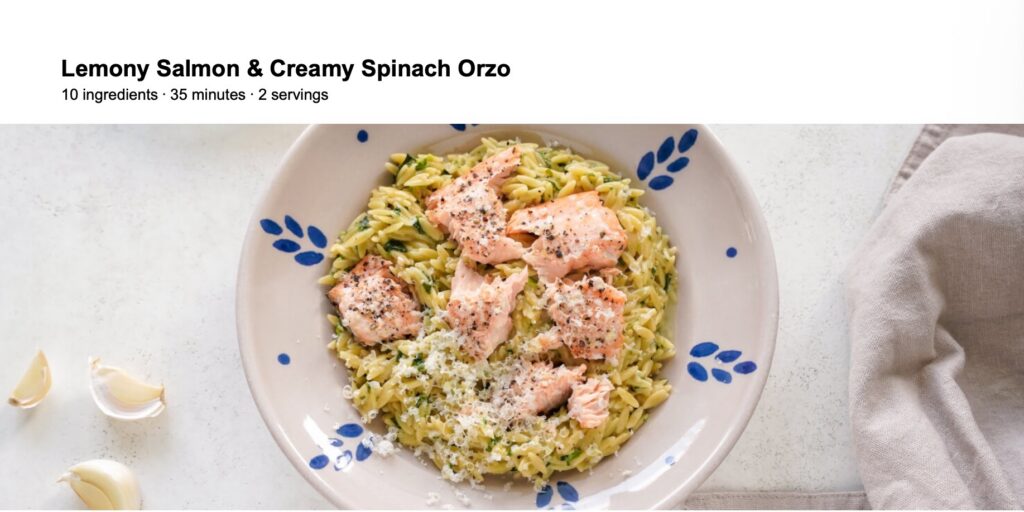
This Week’s Recipe: Lemony Salmon & Creamy Spinach Orzo
This week your body needs:
✔ Protein to repair and rebuild
✔ B12 and folate to support energy
✔ Magnesium and zinc to replenish nutrient stores
✔ Vitamin D to support bones, immunity & hormone health