Menopause Bloating, and Gut Health: Why Your Digestion Changes.
There’s a very specific kind of frustration that creeps in during perimenopause.
You’re eating the same breakfast you’ve eaten for years.
The same soup.
The same salad.
The same “healthy” foods you’ve always relied on.
And yet… by mid-afternoon your stomach feels tight. Puffy. Uncomfortable.
You catch your reflection and wonder how you can look six months pregnant after a perfectly reasonable meal.
So you start questioning yourself.
- Is it gluten?
- Dairy?
- Carbs?
- Am I eating too much?
- Too fast?
- Too late?
You try cutting things out.
You eat smaller portions.
You promise yourself you’ll be “more disciplined.”
But deep down there’s a quieter thought:
Why was this fine before?
That question matters because in most cases, it isn’t that your body has suddenly become intolerant, broken, or incapable.
It’s that your hormones have shifted.
And your gut has shifted with them.
This is not random.
It is not permanent damage.
And it is not a personal failure.
It is your biology adapting to a new hormonal landscape.
What Actually Changes in Menopause
Menopause is not just a change in your cycle.
Hormonal change doesn’t happen in isolation.
Your digestive system, nervous system, blood sugar regulation, liver, microbiome and the way you absorb and use nutrients are all part of the same body.
So when things begin to change in perimenopause, digestion can feel different too.
Food may seem to sit more heavily.
Bowel habits can change.
You may feel more sensitive to foods you’ve eaten for years.
Bloating can appear seemingly out of nowhere.
The temptation is to blame the food.
But the symptom doesn’t necessarily tell us which food to remove.
It gives us a clue about which system may need our attention.
That’s an important distinction.
Because instead of asking:
“What’s wrong with me?”
or
“What do I need to stop eating?”
we can begin asking:
“What does my digestive system need in order to function well?”
That is where understanding your body begins.
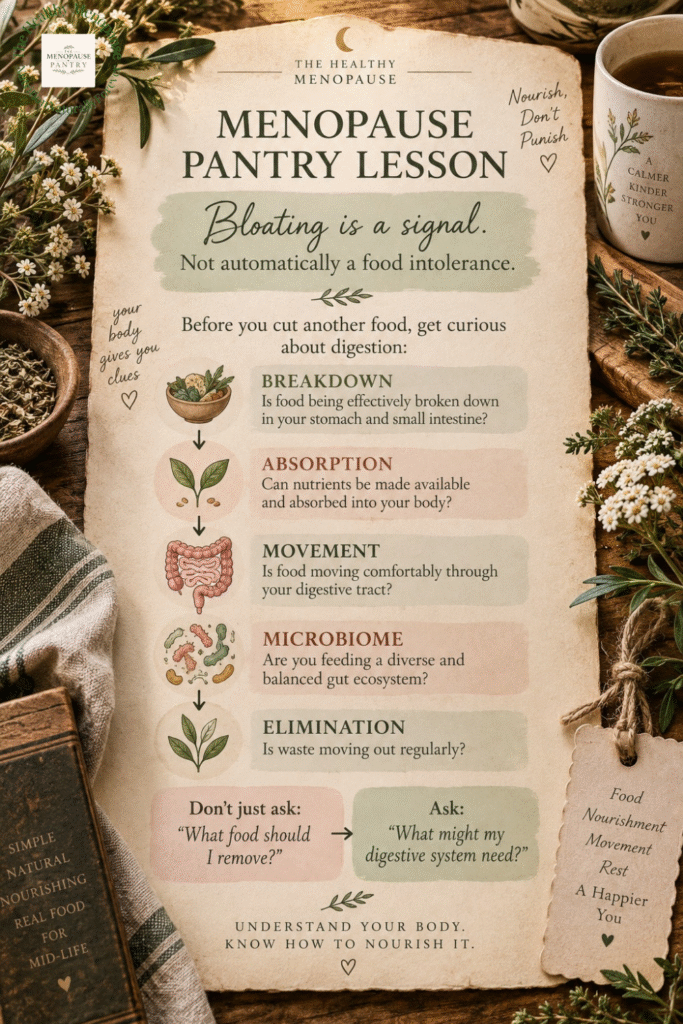
Before We Blame Hormones: What Does Digestion Actually Need?
Digestion is a process.
Before the nutrients in your food can support your hormones, brain, muscles, bones or energy, your body has to be able to access them.
Food needs to be broken down.
Nutrients need to become available for absorption.
Those nutrients need to be absorbed and used.
Food needs to move through the digestive tract.
And what your body doesn’t need has to be eliminated.
So when bloating appears, I’m less interested in immediately labelling a food as the problem and more interested in becoming curious about the process.
Is food being broken down effectively?
Is it moving through comfortably?
Is the microbiome being well nourished?
Are bowel movements regular?
What is happening around meals, are you sitting and eating, or rushing through lunch while answering emails?
None of those questions diagnoses the cause of bloating.
They help us understand the physiological system behind the signal.
And that’s a very different starting point from another elimination diet.
Estrogen and the Microbiome
Estrogen does far more than regulate your cycle.
It also helps shape the community of bacteria living inside your gut.
Within your microbiome is a specific group of bacteria often referred to as the estrobolome. These microbes help metabolise and regulate estrogen in the body. They influence how much estrogen is activated, recycled, or cleared.
When estrogen levels fluctuate in perimenopause, this bacterial balance can shift.
Changes in the microbiome may be one of several factors influencing how digestion feels during this transition.
You may notice:
- Increased bloating
- Greater sensitivity to certain foods
- More inflammation
- Fluid retention
- Changes in bowel habits
This does not necessarily mean you have developed a sudden intolerance.
It may simply mean your internal ecosystem is adjusting to hormonal change.
Lower or fluctuating estrogen can reduce microbial diversity. Diversity is one of the key markers of gut resilience. When diversity drops, the gut can become more reactive and less efficient at clearing used hormones.
But there is another layer to this.
The Brain–Gut–Hormone Axis
Estrogen does not only influence bacteria.
It also interacts closely with serotonin.
Around 90 percent of serotonin is produced in the gut.
Serotonin influences mood, digestive motility, and pain perception.
When estrogen drops or fluctuates, serotonin regulation can shift too.
And this matters because serotonin helps regulate how sensitive your nervous system is to internal sensations.
If serotonin signalling becomes less stable, pain tolerance can lower and gut sensitivity can increase.
Which means the same amount of digestive pressure that felt neutral five years ago may now feel uncomfortable.
The gut may not be more damaged.
It may simply be more sensitive.
This is why bloating can feel sharper. More noticeable. More distressing.
The encouraging part is that serotonin production is strongly influenced by nutrition and lifestyle.
Protein provides the amino acids needed to make serotonin.
Gut bacteria help regulate its production.
Light exposure, movement, and nervous system safety all support it.
This gives us something tangible to work with.
We are not at the mercy of fluctuating hormones.
We can nourish the pathways that help the gut and brain communicate more calmly.
The gut and hormones are not separate conversations.
They are the same conversation.
Gut Motility: When Digestion Feels Slower
If estrogen influences diversity and sensitivity, progesterone influences movement.
Progesterone is often described as the calming hormone. It supports sleep, steadies mood, and balances the stimulating effects of estrogen.
But it also plays a very practical role in digestion.
Progesterone helps regulate smooth muscle, including the muscles that move food through your digestive tract.
When progesterone is robust and well supported, digestion has rhythm.
Food moves.
Waste eliminates.
Pressure does not build.
But in perimenopause, progesterone is usually the first hormone to decline.
Ovulation becomes less consistent.
Cycles shorten or lengthen.
Progesterone production drops.
And when progesterone drops, motility can slow.
Gut motility simply means movement – how effectively food and waste travel through the digestive tract.
Hormonal changes are one of several things that can influence this process during perimenopause.
And this gives us another useful question:
Is my bloating actually telling me that digestion isn’t moving as comfortably as it used to?
This is when women start to say:
Food just sits there.
I feel full for hours.
I’m constipated even though I’m eating well.
Slower transit time means food remains in the digestive tract longer. The longer it sits, the more fermentation occurs. The more fermentation, the more gas and pressure build.
Add in the increased sensitivity we just discussed, and bloating can feel amplified.
This is not random intolerance.
It is slower rhythm plus heightened sensitivity.
And there is another important piece here.
Chronic dieting, under-eating, over-exercising, and ongoing stress all suppress progesterone further.
So if you respond to bloating by restricting more, you may unintentionally deepen the very imbalance contributing to it.
This is why extreme solutions rarely work in menopause.
The body is not asking for less.
It is asking for support.
When blood sugar is stabilised, protein intake is adequate, stress is reduced, and nourishment is consistent, progesterone pathways are better protected.
And when progesterone is supported, digestive rhythm improves alongside it.
Your body is not slowing down to betray you.
It is adjusting to a new hormonal landscape.
And it can find its rhythm again.
The Liver–Gut Hormone Clearance Connection
Your hormones are not just produced.
They are processed and cleared.
Once estrogen has done its job, it travels to the liver to be broken down. From there, it moves into the gut to be eliminated.
This is where digestion really matters.
If bowel movements are sluggish, or the microbiome is imbalanced, used estrogen can be reabsorbed instead of excreted.
This is another reason bowel regularity matters during menopause. Digestion isn’t only about how comfortable your stomach feels after eating. The gut is also one of the body’s routes for eliminating substances it no longer needs.
The liver and gut work as a team.
When the gut is supported with adequate fibre, hydration, protein, and reduced inflammatory load, elimination improves.
And when elimination improves, hormone balance becomes easier.
This is why gut health is never just about digestion.
It is about the entire hormonal ecosystem.
Why Poor Gut Health Amplifies Everything
When the gut is under strain, symptoms rarely stay contained to digestion.
Inflammation in the gut increases inflammatory signalling throughout the body.
Blood sugar becomes less stable.
Cortisol rises more easily.
And elevated cortisol further suppresses progesterone.
It becomes a loop.
Slower motility leads to bloating.
Bloating increases stress.
Stress disrupts hormones.
Hormone imbalance worsens gut function.
On top of that, an imbalanced microbiome can affect nutrient absorption.
If you are not efficiently absorbing protein, minerals, and key B vitamins, your nervous system and hormone pathways are working with less support.
This is why symptoms can begin to stack.
- Brain fog.
- Fatigue.
- Irritability.
- Cravings.
- Weight redistribution.
The gut is not a side issue.
It is central.
And the encouraging truth is this:
When you calm inflammation, stabilise blood sugar, support elimination, and create nervous system safety, the loop can begin to unwind.
The body is not spiralling out of control.
It is responding to input.
Change the input, and the response can change too.
Your Digestive System Is Responsive
After everything you’ve just read, I want you to hear this clearly.
Your gut is not broken.
It is responsive.
The microbiome can change within weeks.
Motility can improve with nourishment and rhythm.
Hormone clearance can become more efficient when the right foundations are in place.
The body is designed to recalibrate.
Menopause is not a permanent digestive decline. It is a transition that asks for a different kind of support.
When you:
✔️ Support gut lining repair with adequate protein
✔️ Feed beneficial bacteria with real food fibre
✔️ Reduce the inflammatory and toxic load
✔️ Create nervous system safety
These are the foundations that give the digestive system what it needs to function well. And your symptoms can then become useful feedback, helping you notice what supports you and what doesn’t.
This is where real relief begins.
What Does Your Digestive System Need to Work Well?
This is not about extreme elimination.
It is about rebuilding foundations.
When you support the body in the right order, digestion often improves more quickly than you expect.
Here is where to begin.
1. Enough Protein and Nourishment
The lining of your digestive tract is made from protein.
Amino acids help maintain and repair the intestinal barrier, support enzyme production, and stabilise blood sugar. Stable blood sugar protects progesterone and reduces cortisol spikes.
Aim for consistent, adequate protein at each meal.
Not bars.
Not powders as a replacement for food.
Real, whole-food protein your body recognises.
2. A Diverse Range of Fibre-Rich Foods
Fibre is not just about preventing constipation.
It feeds beneficial gut bacteria and supports estrogen clearance.
Focus on a variety of colourful plants, vegetables, herbs, nuts, seeds, and properly prepared whole foods.
Diversity feeds diversity.
This is how you rebuild resilience inside the gut.
3. Less for Your Body to Process
Ultra-processed foods, refined seed oils, artificial additives, and endocrine-disrupting chemicals all increase the burden on the gut and liver.
The goal is not perfection.
It is awareness.
Count chemicals, not calories.
When you lower the chemical load, the gut has more capacity to heal and the liver has more capacity to clear hormones efficiently.
4. Time and Space to Digest
Digestion happens best in a state of safety.
If you are eating in stress, rushing between tasks, or constantly in fight-or-flight, your body will prioritise survival over digestion.
Slow down before meals.
Breathe.
Chew properly.
Walk gently after eating.
Get natural light daily.
Safety is not soft advice.
It is biological.
These foundations are simple, but they are powerful.
When you support protein, fibre, detox pathways, and nervous system balance together, the gut and hormones begin working in partnership again.
You Don’t Have to Work This Out Alone
Before You Cut Another Food…
Bloating can be incredibly frustrating.
Especially when the foods you’ve eaten happily for years suddenly seem to be causing problems.
But your first response doesn’t have to be restriction.
Get curious.
Your bloating is a signal.
Rather than immediately asking:
“What food do I need to remove?”
try asking:
“What might my digestive system need in order to do its job well?”
That one question changes the conversation.
Because menopause isn’t a checklist of symptoms to fix individually.
Your body is a collection of interconnected systems, constantly giving you information.
The more you understand those signals, the easier it becomes to know how to nourish yourself.
Understand your body. Know how to nourish it.
🌿 Download The Healthy Menopause Nutrition Guide and take the first step towards understanding your body and knowing how to nourish it.
Related Posts
5 Signs Your Gut Is Healing in Menopause (Even If Symptoms Aren’t Gone Yet)
Menopausal Inflammation Explained: Why Your Joints Ache and Your Body Feels Puffy